
Language tests in the primary classes are mostly grammar and vocabulary: can the child identify a संज्ञा, change the वचन, give the विलोम, or use a मुहावरा correctly? These are skills that build year on year, so short, frequent tests work best. ExamBee now has Hindi for CBSE and ICSE, and Marathi for Maharashtra State Board, for Classes 1 to 4 - in Devanagari, with answer keys. This guide lists the topics for each class, shows sample questions, and explains how to build a test in a few minutes.
Make a paper now: CBSE Class 3 Hindi, ICSE Class 2 Hindi or Maharashtra Board Class 4 Marathi.
Hindi: topics for Class 1 to 4
| Class | विषय (Topics) |
|---|---|
| 1 | स्वर; व्यंजन; मात्राएँ; शब्द-ज्ञान (फल, रंग, जानवर); उल्टे शब्द |
| 2 | मात्राएँ और शब्द; संज्ञा; लिंग; वचन; विलोम शब्द; वाक्य रचना |
| 3 | संज्ञा (व्यक्तिवाचक, जातिवाचक, भाववाचक); सर्वनाम; लिंग और वचन; क्रिया; विशेषण; पर्यायवाची और विलोम शब्द |
| 4 | संज्ञा के भेद; क्रिया और काल; विराम चिह्न; मुहावरे; शब्द-ज्ञान (अनेक शब्दों के लिए एक शब्द) |
Sample Hindi questions
Q1.MCQ (कक्षा 1)'बड़ा' का उल्टा क्या है? (अ) छोटा (ब) मोटा (स) लंबा (द) ऊँचा
Answer: (अ) छोटा
Q2.रिक्त स्थान (कक्षा 2)'घोड़ा' का स्त्रीलिंग ________ है।
Answer: घोड़ी
Q3.सत्य / असत्य (कक्षा 3)'लड़का' व्यक्तिवाचक संज्ञा है।
Answer: असत्य - 'लड़का' जातिवाचक संज्ञा है।
Q4.लघु उत्तर (कक्षा 4)'मुँह में पानी आना' का अर्थ लिखकर वाक्य में प्रयोग कीजिए।
Answer: अर्थ: खाने का लालच होना। वाक्य: गरम-गरम जलेबी देखकर मेरे मुँह में पानी आ गया।
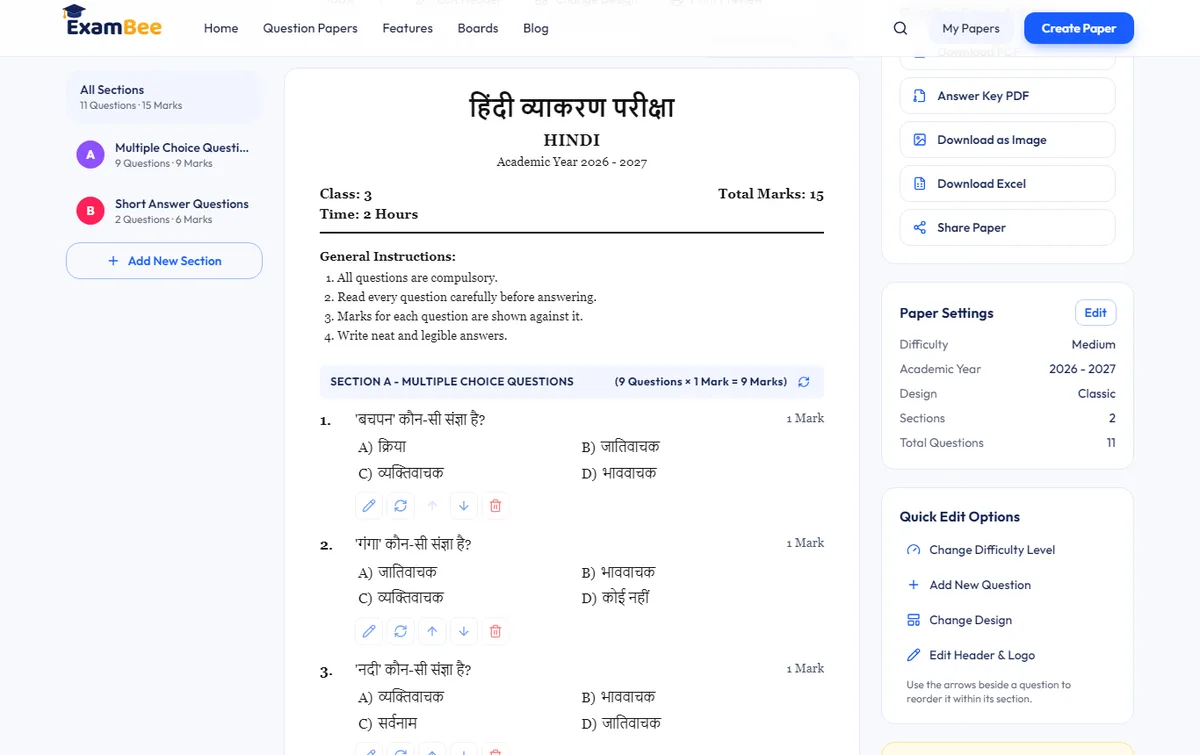
Teaching notes for each class (Hindi)
कक्षा 1 - letters and sounds
The first year is about recognising स्वर and व्यंजन, joining them with मात्राएँ, and reading two- and three-letter words. Test recognition rather than writing: "इनमें से कौन-सा स्वर है?", "'कमल' किस वर्ण से शुरू होता है?". Simple opposites (बड़ा-छोटा, दिन-रात) and everyday words (fruits, colours, animals) build vocabulary.
कक्षा 2 - words to sentences
Children now read short sentences. Introduce संज्ञा as "naming words", simple लिंग pairs (लड़का-लड़की, घोड़ा-घोड़ी) and वचन (केला-केले, नदी-नदियाँ). A good test item asks children to arrange jumbled words into a sentence (राजू / आम / खाता / है).
कक्षा 3 - grammar terms
Grammar terms become explicit: the three kinds of संज्ञा, सर्वनाम, क्रिया and विशेषण, plus पर्यायवाची and विलोम. Ask children to underline the विशेषण in a sentence, or replace a repeated noun with a सर्वनाम - application questions that show real understanding.
कक्षा 4 - usage and expression
By Class 4, children work with काल (past, present, future), विराम चिह्न, मुहावरे and "अनेक शब्दों के लिए एक शब्द". These are ideal for short answers: explain a मुहावरा and use it in a sentence, or punctuate a line of dialogue.
Marathi: topics for Class 1 to 4
| Class | घटक (Topics) |
|---|---|
| 1 | स्वर; व्यंजन; बाराखडी; शब्द ओळख; विरुद्धार्थी शब्द |
| 2 | नाम; लिंग; वचन; शब्दसंपत्ती (समानार्थी व विरुद्धार्थी); वाक्यरचना |
| 3 | नाम व नामाचे प्रकार; सर्वनाम; लिंग व वचन; क्रियापद; विशेषण; शब्दसंपत्ती |
| 4 | नामाचे प्रकार; काळ; विरामचिन्हे; वाक्प्रचार; शब्दसंपत्ती |
Sample Marathi questions
Q5.MCQ (इयत्ता 1)'मोठा' चा विरुद्धार्थी शब्द कोणता? (अ) लहान (ब) जाड (क) उंच (ड) लांब
Answer: (अ) लहान
Q6.रिकाम्या जागा (इयत्ता 2)'नदी' चे अनेकवचन ________ आहे.
Answer: नद्या
Q7.चूक / बरोबर (इयत्ता 4)'तो झोपला होता.' हे वर्तमानकाळातील वाक्य आहे.
Answer: चूक - 'तो झोपला होता' हे भूतकाळातील वाक्य आहे.
Q8.लघु उत्तर (इयत्ता 4)'पाठ थोपटणे' या वाक्प्रचाराचा अर्थ लिहून वाक्यात उपयोग करा.
Answer: अर्थ: कौतुक करणे. वाक्य: पहिला क्रमांक मिळाल्यावर बाईंनी माझी पाठ थोपटली.
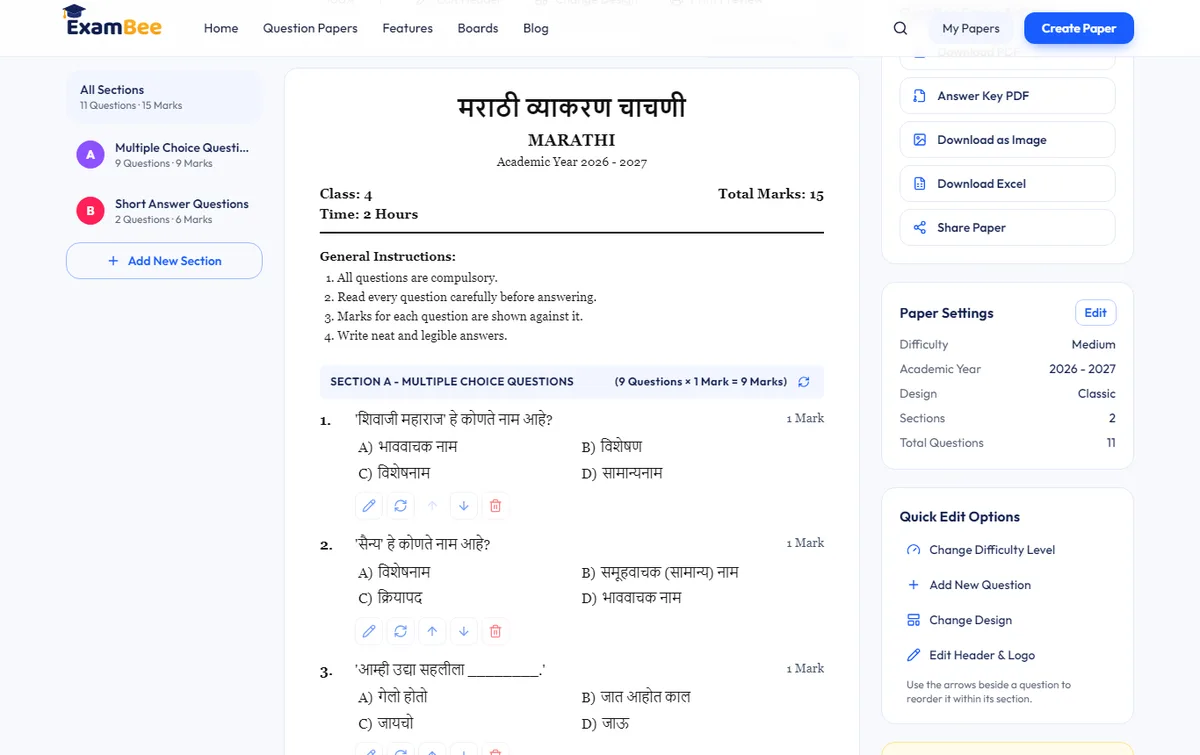
Teaching notes for each class (Marathi)
इयत्ता 1 - अक्षरओळख
Children learn स्वर, व्यंजन and the बाराखडी, and begin reading simple words. Tests check recognition - "'कमळ' हा शब्द कोणत्या अक्षराने सुरू होतो?" - and everyday vocabulary such as fruits, colours and animals, with simple विरुद्धार्थी शब्द (मोठा-लहान, दिवस-रात्र).
इयत्ता 2 - शब्द ते वाक्य
Introduce नाम, लिंग (मुलगा-मुलगी, घोडा-घोडी) and वचन (केळे-केळी, नदी-नद्या), and समानार्थी शब्द. Ask children to form a sentence from jumbled words or to choose the correct sentence among three.
इयत्ता 3 - व्याकरणाची ओळख
The kinds of नाम (सामान्यनाम, विशेषनाम, भाववाचक नाम), सर्वनाम, क्रियापद and विशेषण are introduced. Application questions - replace the repeated noun with a pronoun, or pick out the adjectives in a sentence - work better than definitions alone.
इयत्ता 4 - काळ, विरामचिन्हे, वाक्प्रचार
Class 4 adds काळ (भूतकाळ, वर्तमानकाळ, भविष्यकाळ), विरामचिन्हे and वाक्प्रचार. A 3-mark question asking for the meaning of a वाक्प्रचार and a sentence using it is the classic way to test real understanding.
मात्रा practice words
मात्रा errors are the most common spelling mistakes in both languages, so short daily practice with word lists pays off. Group words by मात्रा and ask children to read them aloud, then use them in MCQs ("किस शब्द में 'ई' की मात्रा है?") and fill-in-the-blank items in the test.
| मात्रा | हिंदी शब्द | मराठी शब्द |
|---|---|---|
| ा (आ) | माला, नाना, बात | आई, बाबा, बाग |
| ि (इ) | दिन, मिला, किताब | दिवा, किरण, शिवा |
| ी (ई) | मीठा, पानी, नदी | पाणी, नदी, खीर |
| ु (उ) | गुड़िया, मुख | फुल, गुरु |
| ू (ऊ) | फूल, मूली, दूध | फूल, दूध, ऊस |
| े / ै | मेला, बैल, पैसा | देव, बैल, पैसा |
| ो / ौ | मोर, घोड़ा, पौधा | मोर, घोडा, चौक |
Common errors and how to test for them
- मात्रा errors - ि vs ी and ु vs ू are the most frequent spelling mistakes. Include "choose the correctly spelt word" MCQs (किताब / कीताब).
- लिंग agreement - children know the pair (लड़का-लड़की) but write "लड़की गया". Test agreement inside sentences, not only pairs.
- Irregular plurals - गुड़िया-गुड़ियाँ, चिड़िया-चिड़ियाँ in Hindi; चिमणी-चिमण्या in Marathi. Give them their own questions.
- विरामचिन्हे - using a full stop (.) or पूर्ण विराम (।) after a question. True/false items catch this quickly.
- मुहावरे / वाक्प्रचार used literally - children translate word by word. Ask for the meaning first, then a sentence.
Oral and activity-based assessment
Written tests are only part of language assessment, especially in Classes 1 and 2. Combine short written tests with oral activities: reading a short paragraph aloud, a picture talk ("चित्र देखकर पाँच वाक्य बोलो" / "चित्र पाहून पाच वाक्ये सांगा"), word games with मात्राएँ, and dictation of ten words. Use the written test to check grammar and vocabulary, and the activities to check fluency, pronunciation and confidence.
More sample questions
Q9.MCQ (कक्षा 4)'मैं कल दिल्ली गया था।' - यह किस काल का वाक्य है? (अ) भूतकाल (ब) वर्तमान काल (स) भविष्यत् काल (द) कोई नहीं
Answer: (अ) भूतकाल
Q10.लघु उत्तर (कक्षा 3)विशेषण छाँटिए: "छोटी बच्ची ने नई फ्रॉक पहनी।"
Answer: छोटी, नई
Q11.MCQ (इयत्ता 3)'गोदावरी' हे कोणते नाम आहे? (अ) विशेषनाम (ब) सामान्यनाम (क) भाववाचक नाम (ड) सर्वनाम
Answer: (अ) विशेषनाम
Q12.लघु उत्तर (इयत्ता 4)भाववाचक नामे बनवा: लहान, गोड, सुंदर
Answer: लहानपण, गोडी, सौंदर्य
Teaching काल / काळ with examples
Tense is the topic Class 4 children find hardest in both languages, because the verb ending changes with tense, gender and number at the same time. Teach it with one verb at a time and three short sentences:
| काल / काळ | हिंदी | मराठी |
|---|---|---|
| भूतकाल / भूतकाळ (past) | राम ने खाना खाया। | राम जेवला. |
| वर्तमान काल / वर्तमानकाळ (present) | राम खाना खाता है। | राम जेवतो. |
| भविष्यत् काल / भविष्यकाळ (future) | राम खाना खाएगा। | राम जेवेल. |
Good test questions ask children to identify the tense of a sentence ("यह किस काल का वाक्य है?" / "हे वाक्य कोणत्या काळातील आहे?") and to change a sentence from one tense to another. The second kind is a strong 2-mark short answer, because it shows whether the child can change the verb correctly, not just name the tense.
Punctuation: विराम चिह्न and विरामचिन्हे
Hindi uses the पूर्ण विराम (।) to end a sentence, while Marathi uses the full stop (.). Both use the प्रश्नवाचक चिह्न / प्रश्नचिन्ह (?), the अल्प विराम / स्वल्पविराम (,) and the exclamation mark (!). True/false questions work well here - "'तुम कहाँ जा रहे हो।' में चिह्न सही है।" (false) - and a short answer can ask children to punctuate a line of dialogue such as माँ ने कहा जल्दी आओ.
Which question types work for language tests
- MCQs - recognise the right form among four (the correct plural, the correct tense, the correctly spelt word).
- Fill in the blanks - produce a form: the feminine of a noun, the plural, the opposite.
- True or false - spot errors in agreement, punctuation and classification.
- Short answers - change a sentence, use a मुहावरा / वाक्प्रचार in a sentence, form abstract nouns.
A 20-mark grammar test blueprint (Class 3-4)
| Section | Type | Questions × marks | Marks |
|---|---|---|---|
| क / अ | बहुविकल्पी प्रश्न (MCQ) | 8 × 1 | 8 |
| ख / ब | रिक्त स्थान भरो / रिकाम्या जागा भरा | 4 × 1 | 4 |
| ग / क | सही / गलत - चूक / बरोबर | 4 × 1 | 4 |
| घ / ड | लघु उत्तर (2 marks) | 2 × 2 | 4 |
| Total | 18 questions | 20 |
In ExamBee, enter 20 marks and these four question types with their marks; tick two or three grammar topics and generate. The section titles on the printed paper are in English, and every question and answer is in Hindi or Marathi.
Vocabulary lists to practise
विलोम शब्द (Hindi opposites)
| शब्द | विलोम | शब्द | विलोम |
|---|---|---|---|
| दिन | रात | अमीर | गरीब |
| आना | जाना | जीत | हार |
| सच | झूठ | मीठा | कड़वा |
| अंदर | बाहर | आदर | अनादर |
| आशा | निराशा | स्वर्ग | नरक |
समानार्थी शब्द (Marathi synonyms)
| शब्द | समानार्थी | शब्द | समानार्थी |
|---|---|---|---|
| पाणी | जल, नीर | घर | सदन, गृह |
| झाड | वृक्ष | आकाश | गगन |
| सूर्य | रवी, भास्कर | चंद्र | शशी, सोम |
| डोंगर | पर्वत, गिरी | मित्र | सखा |
मुहावरे and वाक्प्रचार with meanings
| हिंदी मुहावरा | अर्थ |
|---|---|
| आँखों का तारा | बहुत प्यारा |
| नौ दो ग्यारह होना | भाग जाना |
| पानी-पानी होना | लज्जित होना |
| हाथ बँटाना | मदद करना |
| आग बबूला होना | बहुत गुस्सा होना |
| आसमान सिर पर उठाना | बहुत शोर मचाना |
| मराठी वाक्प्रचार | अर्थ |
|---|---|
| डोळ्यांत पाणी येणे | दुःख होणे |
| पोबारा करणे | पळून जाणे |
| तोंडाला पाणी सुटणे | खाण्याची इच्छा होणे |
| हातभार लावणे | मदत करणे |
| कान टवकारणे | लक्षपूर्वक ऐकणे |
| पाठ थोपटणे | कौतुक करणे |
A complete sample: Class 2 Hindi (15 marks)
Here is a short Class 2 Hindi test of the kind ExamBee generates, with the answers in brackets:
- 1. 'लड़का' का स्त्रीलिंग क्या है? (अ) लड़की (ब) लड़के (स) बच्ची (द) लड़कियाँ [लड़की]
- 2. 'केला' का बहुवचन क्या है? (अ) केले (ब) केलाएँ (स) केलों (द) केली [केले]
- 3. 'अमीर' का विलोम क्या है? (अ) गरीब (ब) धनी (स) राजा (द) बड़ा [गरीब]
- 4. किस शब्द में 'ओ' की मात्रा है? (अ) मोर (ब) मार (स) मीर (द) मूर [मोर]
- 5. 'नदी' का बहुवचन ________ है। [नदियाँ]
- 6. 'सुबह' का विलोम ________ है। [शाम]
- 7. 'बकरी' स्त्रीलिंग शब्द है। (सही / गलत) [सही]
- 8. 'राजा' स्त्रीलिंग शब्द है। (सही / गलत) [गलत]
- 9. शब्दों को सही क्रम में लगाओ: खाता / आम / राजू / है [राजू आम खाता है।]
- 10. अपने बारे में दो वाक्य लिखिए। [कोई भी दो सही वाक्य]
A complete sample: Class 3 Marathi (15 marks)
- 1. 'गोदावरी' हे कोणते नाम आहे? (अ) विशेषनाम (ब) सामान्यनाम (क) भाववाचक नाम (ड) सर्वनाम [विशेषनाम]
- 2. नामाऐवजी येणाऱ्या शब्दाला काय म्हणतात? (अ) सर्वनाम (ब) विशेषण (क) क्रियापद (ड) नाम [सर्वनाम]
- 3. 'शिक्षक' चे स्त्रीलिंगी रूप कोणते? (अ) शिक्षिका (ब) शिक्षकी (क) शिक्षकीण (ड) शिक्षा [शिक्षिका]
- 4. 'मुले बागेत खेळतात.' - यातील क्रियापद कोणते? (अ) खेळतात (ब) मुले (क) बागेत (ड) काहीही नाही [खेळतात]
- 5. हत्ती ________ असतो. (मोठा / मोठेपणा) [मोठा]
- 6. 'गोष्ट' चे अनेकवचन ________ आहे. [गोष्टी]
- 7. 'कष्टाळू' हे विशेषण आहे. (चूक / बरोबर) [बरोबर]
- 8. 'लेखणी' हे सर्वनाम आहे. (चूक / बरोबर) [चूक]
- 9. नामाऐवजी सर्वनाम वापरा: 'राधा शाळेत गेली. राधाने अभ्यास केला.' [राधा शाळेत गेली. तिने अभ्यास केला.]
- 10. वचन बदला: रात्र, डोळा, मुलगी [रात्री, डोळे, मुली]
A simple rubric for short answers
Short answers in language tests are easiest to mark fairly with a three-level rubric. For a 2-mark "use the idiom in a sentence" question: 2 marks for the correct meaning and a correct, meaningful sentence; 1 mark for the correct meaning but a weak or partly wrong sentence (or a good sentence without the meaning); 0 for neither. Do not deduct marks for small spelling slips in a grammar question unless spelling is what is being tested - children should be rewarded for the grammar skill.
Children with a different home language
Many classrooms have children whose home language is not Hindi or Marathi. For them, a grammar test can feel like a reading test. Read the questions aloud, allow extra time, start with picture-and-word recognition, and use the "easy" difficulty setting when you generate. Track progress over several short tests rather than one long one - growth is the real measure.
Practice at home
Parents often ask how to help with grammar at home. Share the answer key and suggest five minutes a day: say a word and ask for its विलोम or वचन, read a sentence and find the संज्ञा / नाम, or use one मुहावरा or वाक्प्रचार in conversation. Short, regular practice builds language far more than one long session before the test.
How grammar builds from Class 1 to 4
Grammar topics return each year with more depth, so tests should too. A child who learns to spot a naming word in Class 1 classifies nouns into types by Class 3 and forms abstract nouns (भाववाचक संज्ञा / भाववाचक नाम) in Class 4. Plan tests that revisit earlier topics briefly before testing the new one.
| Skill | Class 1-2 | Class 3-4 |
|---|---|---|
| Nouns | Recognise naming words | Types of nouns, abstract nouns |
| Gender and number | Simple pairs (लड़का-लड़की) | Irregular forms, applying in sentences |
| Verbs and tense | Action words | Past, present and future tense |
| Vocabulary | Opposites | Synonyms, one-word substitutes, idioms |
| Writing | Arrange words into a sentence | Punctuation and short answers |
A month of grammar practice
Grammar sticks when it is practised a little every week rather than all at once before the exam. The plan below covers one month for Class 3 or 4 and works the same way for Hindi and Marathi. Each week has one new topic, a short oral activity and a five-mark written check, and the month ends with a 20-mark test that revises all four topics.
| Week | Hindi topic | Marathi topic | Weekly check |
|---|---|---|---|
| 1 | संज्ञा और उसके भेद | नाम आणि त्याचे प्रकार | 5 MCQs from a reading passage |
| 2 | लिंग और वचन | लिंग आणि वचन | Change the gender or number - 5 words |
| 3 | सर्वनाम और विशेषण | सर्वनाम आणि विशेषण | Fill in the blanks - 5 sentences |
| 4 | काल | काळ | Change the tense - 5 sentences |
| End of month | Revision test | Revision test | 20 marks, mixed question types |
For the weekly checks, generate a small paper with only one chapter ticked and a handful of objective questions. For the end-of-month test, tick all four topics and follow the 20-mark blueprint described earlier in this guide. Maharashtra schools can find every class and subject on the Maharashtra Board page, and the Class 1-4 unit test guide covers English, Maths and EVS tests in the same classes.
Keep it light
Weekly checks should take ten minutes at most. Mark them in class, talk about the mistakes, and move on - the goal is regular practice, not more exams.Make a Hindi or Marathi test
- 1
Pick the class and topics
Choose the board, class and Hindi or Marathi, then tick one or two grammar topics.
- 2
Keep it short
15-20 marks: mostly MCQ, fill in the blanks and true/false, plus two short answers.
- 3
Generate and check
Log in, generate, read the paper aloud once, swap anything unsuitable and download the PDF.
Tips for language teachers
- Write the exam name in Hindi or Marathi (for example हिंदी व्याकरण परीक्षा) - it prints at the top of the paper.
- For Class 1, read questions aloud; the options are short words children can recognise.
- Add one dictation or handwriting section of your own - use 'Add question' on the paper page.
- Give the answer key to parents to practise at home.
For English, Maths and EVS in the same classes, see our Class 1-4 unit test guide. The launch post New on ExamBee: Class 1 to 4 question papers lists every board and subject, and the Maharashtra Board page has all Maharashtra classes.
Frequently asked questions
Can I make Hindi grammar tests for Class 1 to 4 on ExamBee?+
Yes. Hindi is available for CBSE and ICSE, Classes 1-4, with topics from स्वर, व्यंजन and मात्राएँ in Class 1 to संज्ञा के भेद, काल, विराम चिह्न and मुहावरे in Class 4.
Is Marathi available for Maharashtra State Board?+
Yes. Marathi is available for Maharashtra State Board, Classes 1-4, from स्वर, व्यंजन and बाराखडी to नामाचे प्रकार, काळ, विरामचिन्हे and वाक्प्रचार.
Do Hindi and Marathi papers print correctly?+
Yes. ExamBee renders Devanagari correctly in the paper preview, the PDF and the image download.
Why are the chapters grammar topics and not textbook lessons?+
Questions on a textbook story need the story itself, which is copyrighted. Grammar and vocabulary topics are what most primary language tests are built from, and they work with any textbook.
Can I mix Hindi questions with my own?+
Yes. After generating, add your own questions, edit any question, or swap one for another from the same chapter before downloading.
At what age should children start grammar tests in Hindi or Marathi?+
Simple recognition activities (स्वर, व्यंजन, मात्राएँ / बाराखडी) work from Class 1. Short written grammar tests are most useful from Class 2 or 3, alongside reading and speaking activities.
How long should a primary grammar test be?+
Short: 10-15 marks for Classes 1-2 and 15-20 marks for Classes 3-4, taking 25-40 minutes.
Can I print the exam name in Hindi or Marathi?+
Yes. Type the exam name in Devanagari on the configure screen - for example हिंदी व्याकरण परीक्षा or मराठी व्याकरण चाचणी - and it prints at the top of the paper.
Are the Marathi questions suitable for Maharashtra State Board?+
Yes. They follow the grammar topics taught in Maharashtra primary classes - नाम, सर्वनाम, लिंग, वचन, क्रियापद, विशेषण, काळ, विरामचिन्हे and वाक्प्रचार.