Making a test for a seven-year-old is harder than it looks. The questions must be short and clear, the layout friendly, the marks small, and the paper has to check what was actually taught - not what an older textbook used to teach. ExamBee now covers Classes 1 to 4 for CBSE, ICSE and Maharashtra State Board, so primary teachers can build a unit test in about ten minutes. This guide explains how to plan good primary tests and how to make one, subject by subject.
What makes a good primary test
- Short and focused. One or two chapters per test, 20-25 marks, 30-45 minutes.
- Mostly one-mark questions. MCQs, fill in the blanks, true or false and one-word answers suit young learners.
- A few short answers. Two or three 2-mark questions let children write a sentence or show a calculation.
- Easy start, gentle finish. Begin with confidence-building questions; place the harder ones in the middle.
- Clear printing. Big fonts, spacing between questions and your school's name on top make the paper feel familiar.
Assessment in the early years
India's National Curriculum Framework for the Foundational Stage (covering ages 3-8, i.e. up to Class 2) recommends that young children are assessed through observation and simple, stress-free activities rather than formal exams. From Class 3 onwards, short written tests become more useful, still alongside class work and projects. So the "unit test" for Class 1 and 2 is best thought of as a short, friendly worksheet or quiz that shows the teacher what each child has understood - not a high-stakes exam.
That changes how you build the paper. For Classes 1-2, keep it to 10-20 marks, read the questions aloud, use pictures and real objects in class around it, and never use it to rank children. For Classes 3-4, 20-25 marks over 30-45 minutes is a good size, and the results can guide which topics to revise.
What to expect at each class
Class 1
Children are learning to read. Questions must be very short, with one idea each: "Which number comes after 7?", "Which of these is a fruit?", "Circle the naming word". Options should be single words or numbers. Oral administration (the teacher reads, children mark) works well.
Class 2
Children read simple sentences independently. Add fill-in-the-blank items and two-step word problems ("A shop had 45 kites. It sold 18. How many are left?"). Short answers can ask for one sentence.
Class 3
Reading is more fluent, so tests can include instructions with two parts, three-digit arithmetic, and EVS questions about everyday life (festivals, plants and animals, water, food). Short answers of two or three sentences are reasonable.
Class 4
Children can handle longer word problems, fractions and measurement conversions, grammar such as tenses and degrees of comparison, and EVS questions that ask "why" (why houses in deserts have thick walls). This is a good class to introduce a simple comprehension or writing question.
English (Classes 1-4)
For English, ExamBee organises questions by grammar and vocabulary topics - the sections most primary class tests are built from - so they work with any reader, including NCERT's Mridang (Classes 1-2) and Santoor (Classes 3-5).
| Class | Topics |
|---|---|
| 1 | The alphabet and vowels; naming words; action words; opposites; one and many; rhyming words and a/an |
| 2 | Common and proper nouns; pronouns; verbs and is/am/are; describing words; vocabulary and spelling; capital letters and punctuation |
| 3 | Gender of nouns; pronouns; verbs and tenses; adjectives; articles and prepositions; synonyms and antonyms; kinds of sentences |
| 4 | Collective and abstract nouns; tenses; degrees of comparison; adverbs and conjunctions; punctuation and spelling; homophones; comprehension and writing |
Q1.MCQ (Class 1)Choose the correct word: ___ apple. (a) a (b) an (c) the two (d) many
Answer: an apple - 'apple' begins with a vowel sound.
Q2.Short answer (Class 3)Change into the past tense: "I walk to school."
Answer: I walked to school.
Make an English paper for CBSE Class 2 or ICSE Class 4.
Notes for English teachers
In Classes 1 and 2, English tests should check recognition first - pick the vowel, circle the naming word, choose the rhyming word - and only then ask children to produce a word (the opposite of "hot", the plural of "box"). In Classes 3 and 4, shift towards using grammar inside sentences: change a sentence into the past tense, fill in the right preposition, join two sentences with "and" or "because". Vocabulary items (synonyms, antonyms, homophones) make quick one-mark questions at every level.
Q7.Fill in the blank (Class 2)We ____ friends. (is / are)
Answer: are
Q8.Short answer (Class 4)Write the three degrees of comparison of "happy".
Answer: Happy, happier, happiest.
Mathematics (Classes 1-4)
Maths is organised by concept: numbers, addition and subtraction, multiplication, division and fractions, shapes, measurement, time, money, patterns and data handling. The topics line up with NCERT's new books (Joyful Mathematics for Classes 1-2 and Maths Mela for Classes 3-5) as well as ICSE and Maharashtra primary maths. Every answer is calculated, so you never have to re-check the key.
| Class | Main topics |
|---|---|
| 1 | Numbers up to 20 and 100, addition, subtraction, shapes, measurement, time, money, patterns, data |
| 2 | Place value, 2-digit addition and subtraction, multiplication as groups, shapes and lines, measurement, calendar, money |
| 3 | Numbers up to 1000, 3-digit addition and subtraction, tables, division and halves/quarters, solids, units, time, money |
| 4 | Numbers up to 10,000, 4-digit operations, 2-digit multiplication, division with remainder, fractions, measurement, symmetry and perimeter |
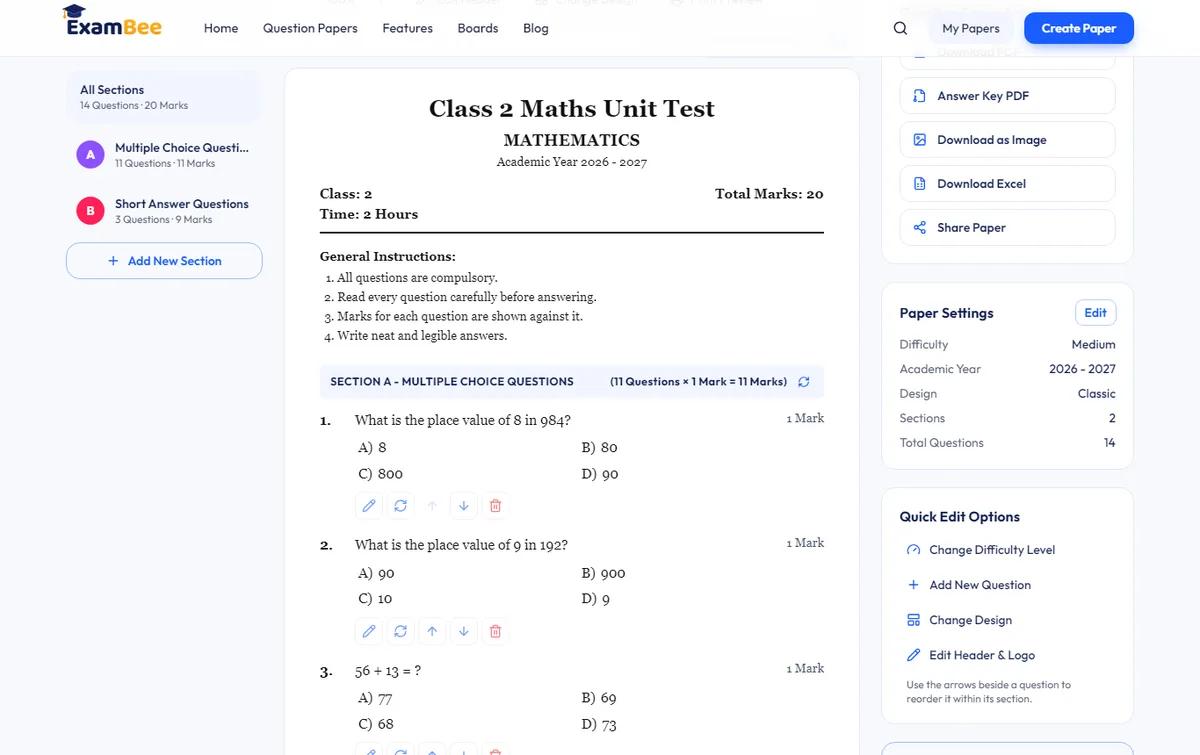
Q3.Short answer (Class 2)Aman has ₹50. He buys a pen for ₹15. How much money does he have left?
Answer: ₹50 - ₹15 = ₹35.
Q4.MCQ (Class 4)Which fraction is equal to 1/2? (a) 2/4 (b) 1/4 (c) 2/3 (d) 3/4
Answer: (a) 2/4 is equal to 1/2.
EVS (Environmental Studies)
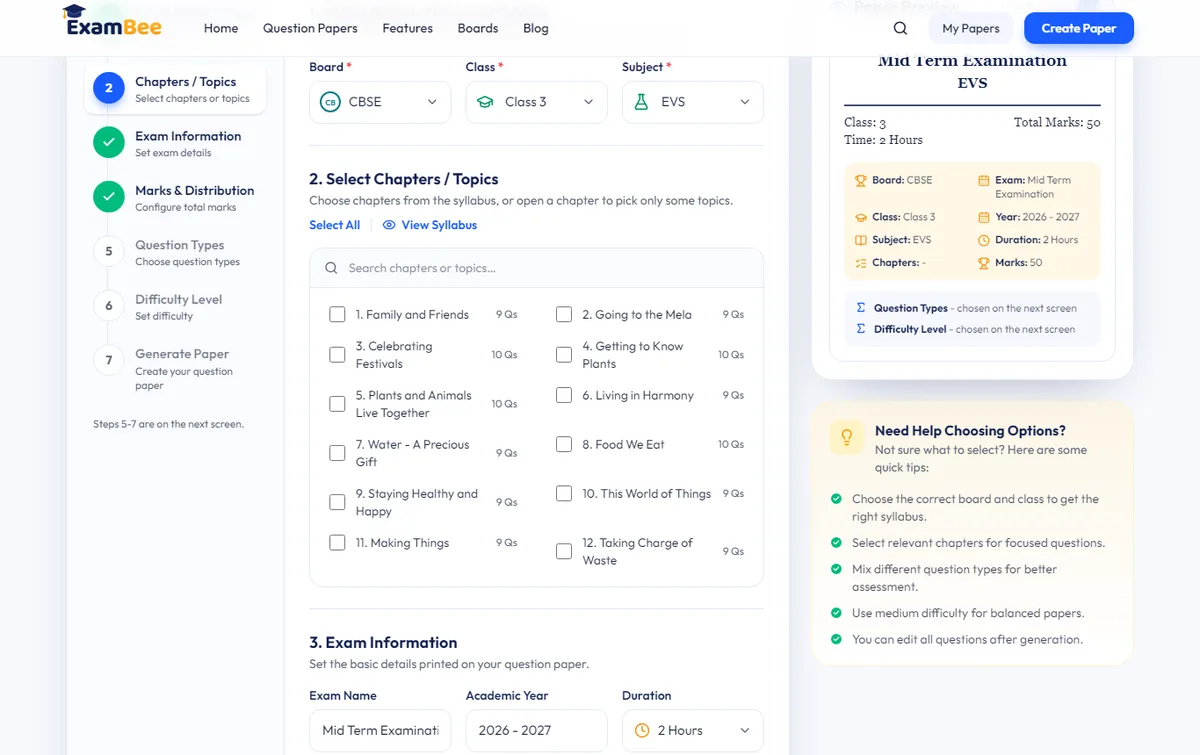
For CBSE, Classes 3 and 4 EVS follow the new NCERT textbook Our Wondrous World chapter by chapter - from "Family and Friends" and "Going to the Mela" to "Taking Charge of Waste" in Class 3, and "Living Together" to "Our Sky" in Class 4. ICSE has EVS from Class 1 (body and senses, family, food, plants, animals, water and weather, good habits), and Maharashtra Board from Class 3.
Q5.True / False (Class 3)Burning garbage keeps the air clean.
Answer: False - burning garbage pollutes the air.
Q6.Short answer (Class 4)Write the stages in the life cycle of a frog.
Answer: Egg → tadpole → froglet → adult frog.
Make an EVS paper for CBSE Class 3, ICSE Class 1 or Maharashtra Board Class 4.
CBSE Class 3 EVS: what each chapter covers
| Chapter (Our Wondrous World) | What to test |
|---|---|
| Family and Friends | Types of families, relations (aunt, uncle, cousins), how family members help each other |
| Going to the Mela | Stalls, rides, local artisans, staying safe in a crowd |
| Celebrating Festivals | Festivals of different states (Pongal, Baisakhi, Onam, Bihu), why we celebrate |
| Getting to Know Plants | Parts of a plant and their work, trees, herbs, climbers |
| Plants and Animals Live Together | Bees and flowers, birds and trees, how animals spread seeds |
| Living in Harmony | Kindness, respect for differences, sharing |
| Water - A Precious Gift | Sources of water, saving water, rainwater harvesting |
| Food We Eat | Food groups, cooking methods, regional food |
| Staying Healthy and Happy | Good habits, exercise, rest, sharing feelings |
| This World of Things | Natural and man-made things, materials |
| Making Things | Paper, cloth, clay and recycling old things |
| Taking Charge of Waste | Wet and dry waste, composting, the three Rs |
CBSE Class 4 EVS: what each chapter covers
| Chapter (Our Wondrous World) | What to test |
|---|---|
| Living Together | Communities of people and animals, why living together helps |
| Exploring Our Neighbourhood | Important places (bank, post office, hospital), reading simple maps |
| Nature Trail | Birds, trees and insects; migration; respecting nature on a walk |
| Growing up with Nature | Seeds and germination, life cycles of a frog and a butterfly |
| Food for Health | Nutrients and their sources, a balanced diet |
| Happy and Healthy Living | Hygiene, mosquito-borne diseases, sleep and exercise |
| How Things Work | Simple machines - wheel, pulley, lever, ramp |
| How Things are Made | From cotton to cloth, clay to pots, sugarcane to jaggery |
| Different Lands, Different Lives | Houses, clothes and food in deserts, mountains and rainy regions |
| Our Sky | Sun, Moon and stars, day and night, phases of the Moon |
Common maths misconceptions to test for
- Place value: reading 405 as 'forty-five' or writing 'seven hundred and six' as 7006.
- Subtraction with borrowing: subtracting the smaller digit from the larger in each column regardless of position.
- Time: confusing the hour and minute hands, or thinking there are 100 minutes in an hour.
- Fractions: believing 1/4 is bigger than 1/2 because 4 is bigger than 2.
- Measurement: mixing units - 'a pencil is 15 metres long'.
ExamBee's maths pools include true-or-false items aimed at exactly these errors, so a short test quickly shows which children need more practice with place value or borrowing.
Hindi and Marathi
Hindi (CBSE and ICSE) and Marathi (Maharashtra Board) are covered from Class 1, starting with वर्णमाला and मात्राएँ / बाराखडी and moving to grammar - संज्ञा, सर्वनाम, लिंग, वचन, काल and मुहावरे in Hindi; नाम, सर्वनाम, काळ and वाक्प्रचार in Marathi. Papers print correctly in Devanagari. We wrote a separate guide to Hindi and Marathi grammar tests with sample questions for each class.
Sample papers by class
Class 1 English - 15 marks
Five MCQs on vowels and naming words (5), five fill-in-the-blanks on opposites and plurals (5), five true/false items on action words and rhyming words (5). Read every question aloud; the whole test takes about 25 minutes.
Class 2 Maths - 20 marks
Eight MCQs on 2-digit addition and subtraction (8), four fill-in-the-blanks on multiplication as groups (4), and four 2-mark word problems on money and measurement (8). Word problems use simple names and everyday objects.
Class 3 EVS - 25 marks
Eight MCQs across "Water - A Precious Gift" and "Food We Eat" (8), four fill-in-the-blanks (4), five true/false items (5) and four 2-mark short answers such as "Write two ways to save water" (8).
Class 4 English - 25 marks
Eight MCQs on tenses and degrees of comparison (8), four fill-in-the-blanks (4), five true/false items on punctuation (5), and four 2-mark short answers - change into the future tense, join two sentences with "because", and write the three degrees of an adjective (8).
Planning a term of tests
| Month | Class 1-2 | Class 3-4 |
|---|---|---|
| 1 | Oral quiz + 10-mark worksheet | 20-mark unit test (1 chapter) |
| 2 | 15-mark test on two topics | 25-mark unit test (2 chapters) |
| 3 | Activity-based assessment | 25-mark unit test (2 chapters) |
| 4 | 15-mark test + oral reading | Term test (all chapters so far, 40 marks) |
Writing questions young children can read
- One idea per question. "Which is heavier: a pumpkin or a grape?" - not two comparisons in one sentence.
- Familiar words and names. Riya, Aman, mangoes and balloons are easier than unfamiliar settings.
- Short options. Single words or numbers; avoid "all of the above" at this age.
- No trick questions. Test what was taught, in the way it was taught.
- Positive wording. Avoid double negatives ("Which is not unsafe?").
ExamBee's Class 1-4 questions are written with these rules. If a question does not suit your class, edit its wording on the paper page or swap it for another from the same chapter with one click.
Tests for mixed-ability classes
Every primary class has children reading well above and well below the class level. Two simple ways to handle this with a generator: make two versions of the same test - one at "easy" difficulty and one at "medium" - covering the same chapters, or keep one paper but order it from easy to hard so every child completes the first half confidently. For children who need extra support, the teacher can read the paper aloud and accept oral answers for the short-answer questions.
Choosing the difficulty
ExamBee lets you pick easy, medium, hard or mixed questions. For primary classes, "easy" works well for the first test on a new topic, when you want to see whether children have the basic idea. "Medium" suits the end-of-chapter test. "Mixed" is best for term tests, because it gives every child questions they can answer while still showing who has mastered the topic. If a section does not have enough questions at the level you choose, ExamBee fills it from the nearest level and tells you on the paper page.
ExamBee features primary teachers use most
- Your school header and logo - school name, address and phone with your logo, printed on every paper.
- Paper designs - pick a layout before generating, or change it afterwards with "Change Design".
- Swap and edit - replace a single question with another from the same chapter, or edit its wording.
- Regenerate a section - get fresh MCQs (or any section) for a second division in one click.
- My Papers - every paper you generate is saved to your account, so next term's test starts from this term's.
- Downloads - PDF for printing, image for sharing on a class group, Excel for your own records.
All of this is free with an ExamBee account. See the full list on the features page.
Feedback that helps young children
A unit test is only useful if the child learns something from it. For Classes 1 to 4, short spoken feedback works better than long written comments. Return the paper the next day, go through two or three common mistakes with the whole class on the board, and then let each child correct their own errors in a different colour. Praise effort and specific progress - "you wrote all the plurals correctly this time" - rather than only the total.
Keep a simple record of which questions most children got wrong. If more than half the class missed a question, the topic needs reteaching, not just correction. You can then generate a short follow-up worksheet on the same chapter a week later to check that the gap has closed. Ready sample papers for each board are on the question papers page.
Sharing results with parents
A unit test is most useful when parents know what was tested. Download the answer key PDF along with the paper and share both at the parent-teacher meeting, or send the paper link so parents can see the questions. A short note - "Riya was confident with addition; we will practise subtraction with borrowing next" - turns a mark into a plan.
Make a unit test in 10 minutes
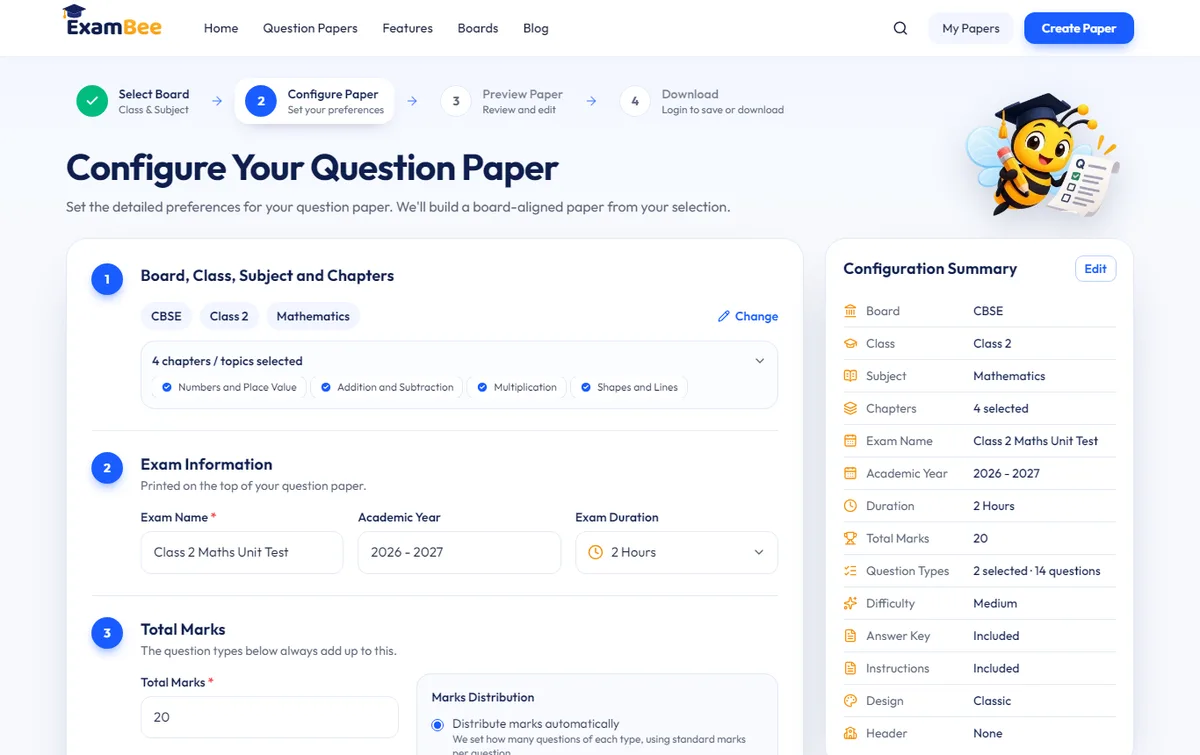
- 1
Choose class and chapters (2 min)
Pick the board, class and subject, then tick the chapter or two you have just finished.
- 2
Set marks and types (3 min)
Enter the exam name and 20 or 25 marks; keep mostly MCQ, fill in the blanks and true/false, with 2-3 short answers.
- 3
Generate, check, print (5 min)
Log in, generate, read through, swap any question you don't like, add your school logo and download the PDF.
A sample 25-mark blueprint for Class 3
| Section | Type | Questions | Marks |
|---|---|---|---|
| A | MCQ | 8 | 8 |
| B | Fill in the blanks | 4 | 4 |
| C | True or false | 5 | 5 |
| D | Short answer (2 marks) | 4 | 8 |
| Total | 21 | 25 |
For more on balancing marks and difficulty, read our question paper blueprint guide.
Tips from primary teachers
- Read the paper aloud to Class 1 children - the questions are short so they can follow along.
- Use 'Regenerate' on one section to make a different version for the second division.
- Keep the answer key PDF for parents' meetings - it shows exactly what was tested.
- Children love seeing their school logo on top; add it once and reuse the design.
All Class 1-4 boards and subjects are listed on the supported boards page, and the launch details are in New on ExamBee: Class 1 to 4 question papers.
Frequently asked questions
Which subjects can I make Class 1-4 papers for on ExamBee?+
English and Mathematics for all three boards; EVS for CBSE (Classes 3-4), ICSE (Classes 1-4) and Maharashtra Board (Classes 3-4); Hindi for CBSE and ICSE; and Marathi for Maharashtra State Board.
How long should a Class 1 or Class 2 test be?+
Short - about 20 to 25 marks and 30 to 45 minutes, with mostly one-mark questions (MCQ, fill in the blanks, true or false) and two or three short answers.
Do CBSE EVS chapters match the NCERT book?+
Yes. CBSE Class 3 and 4 EVS in ExamBee use the chapter names of the new NCERT textbook Our Wondrous World (12 chapters in Class 3, 10 in Class 4).
Are the maths answers checked?+
Yes. Class 1-4 maths questions are generated with calculated answers, so every arithmetic answer is correct. Word problems use simple Indian names and everyday objects.
Can I add my school name and logo to the paper?+
Yes. Add the school name, address, phone and logo, and pick a paper design, before you generate. You can also change them later on the paper page.
Should Class 1 and 2 children write formal exams?+
The NCF for the Foundational Stage recommends observation and stress-free activities for young children rather than formal exams. Short, friendly worksheets and quizzes - read aloud by the teacher - are a better fit for Classes 1 and 2.
How many questions should a Class 3 unit test have?+
About 20 questions for 25 marks works well: eight MCQs, four fill in the blanks, five true/false items and four 2-mark short answers.
Can I make two versions of the same test?+
Yes. Generate the paper, then use Regenerate on a section (or the whole paper) to get different questions from the same chapters for a second division.
Do Class 1-4 papers come with answer keys?+
Yes. Every paper has an answer key that you can show on screen or download as a separate PDF.