
Every good question paper starts before the first question is written. Experienced teachers and paper setters first draw up a blueprint - a simple table that says how many marks go to each chapter, which question types to use, and how difficult the paper should be. Boards like CBSE publish blueprints for their exams for exactly this reason: they make papers fair, balanced and comparable. This guide explains how to build one, with worked blueprints for Class 5, Class 10 and Class 12.
Why use a blueprint?
- Coverage. Every taught chapter gets marks in proportion to its importance - no chapter is forgotten or over-tested.
- Balance. The paper mixes recall, understanding and application instead of rewarding memory alone.
- Fairness. Two sections or two years of the same test are comparable.
- Speed. Once the blueprint is fixed, choosing questions is quick - especially with a generator.
The four parts of a blueprint
1. Marks per chapter or unit
Start with the total and divide it by chapter. A simple rule: give each chapter a share in proportion to teaching periods spent on it, then adjust towards the board's weightage for the unit. For a CBSE Class 12 Biology mock, for example, follow the board's unit weightage:
- Reproduction16 marks
- Genetics and Evolution20 marks
- Biology and Human Welfare12 marks
- Biotechnology12 marks
- Ecology10 marks
Unit weightage from the CBSE 2025-26 curriculum (as reported by education portals).
2. Question types and marks per question
Decide which types to use and how many marks each carries. Typical school patterns are 1-mark objective questions (MCQs, fill in the blanks, true or false, one-word), 2- or 3-mark short answers and 5-mark long answers. Younger classes get more 1-mark questions; senior classes more short and long answers.
3. Difficulty mix
A widely used split is roughly 30% easy, 50% medium and 20% hard, by marks. Easy questions let every student start well; hard ones separate the top performers. For a diagnostic test early in the term, make it easier; for a pre-board, make it closer to the board.
4. Thinking levels (Bloom's taxonomy)
Bloom's taxonomy sorts questions by the thinking they need: remember, understand, apply, analyse, evaluate, create. Boards now expect a good share of competency-based (application and analysis) questions, especially in Classes 10 and 12. In practice: MCQs and fill in the blanks test remembering and understanding; numericals and case-based questions test application; "compare", "explain why" and "justify" questions test analysis and evaluation.
| Level | Typical verbs | Example |
|---|---|---|
| Remember | define, state, name, list | State Ohm's law. |
| Understand | explain, describe, classify | Explain why a fuse is connected in the live wire. |
| Apply | calculate, use, solve | Find the current through a 4 Ω resistor connected to a 2 V cell. |
| Analyse | compare, distinguish, examine | Distinguish between mitosis and meiosis. |
| Evaluate | justify, assess, argue | Assess the impact of the 1991 economic reforms. |
Building a blueprint step by step
Here is the full process for a 40-mark Class 10 term test covering four chapters, starting from the teaching time spent on each chapter.
Step 1: list chapters and teaching periods
| Chapter | Periods taught | Share of time |
|---|---|---|
| Chapter A | 12 | 30% |
| Chapter B | 10 | 25% |
| Chapter C | 10 | 25% |
| Chapter D | 8 | 20% |
| Total | 40 | 100% |
Step 2: convert time into marks
Multiply each share by the total marks: Chapter A gets 30% of 40 = 12 marks, B and C get 10 each, D gets 8. If the board gives one of these chapters a much larger weightage, nudge its marks up by a few and take them from the others - the total must stay at 40.
Step 3: choose question types per chapter
A 12-mark chapter could be 3 MCQs (3), 1 true/false (1), 1 short answer (3) and 1 long answer (5). A 10-mark chapter could drop the long answer for two short answers. Write this down chapter by chapter.
Step 4: check difficulty and thinking levels
Mark each planned question as easy, medium or hard, and as remember, understand or apply. If more than half the marks are "remember", swap some MCQs for application questions. If the hard questions add up to more than about a quarter of the marks, the paper is probably too difficult for a term test.
The two-way table: content × thinking level
Boards and teacher-training courses often describe a blueprint as a two-way table - chapters down the side, thinking levels or question types across the top, and marks in each cell. It makes gaps obvious at a glance: an empty column means a skill is not tested at all.
| Chapter | Remember | Understand | Apply | Total |
|---|---|---|---|---|
| Chapter A | 3 | 4 | 5 | 12 |
| Chapter B | 3 | 4 | 3 | 10 |
| Chapter C | 2 | 5 | 3 | 10 |
| Chapter D | 2 | 3 | 3 | 8 |
| Total | 10 (25%) | 16 (40%) | 14 (35%) | 40 |
Internal choice and options
Board papers often give internal choice in longer questions - "answer either (a) or (b)". If you include choice, both options must test the same chapter at the same difficulty and carry the same marks, or the paper is no longer fair. In practice, choice is best kept for long answers in senior classes; primary and middle-school tests are simpler and fairer without it.
Validity, reliability and fairness
- Validity - does the paper test what was taught and what the syllabus expects? A blueprint built from the syllabus and teaching time is the main tool for this.
- Reliability - would a student score about the same on a similar paper? More questions, clear marking schemes and answer keys make scores more reliable.
- Fairness - is the language clear, are there no trick questions, and is the paper possible in the time? Read the paper as a student would before printing.
How much time per question?
A practical rule of thumb for school tests is about one to one-and-a-half minutes per mark, plus reading time. A 40-mark paper needs roughly 60-75 minutes; an 80-mark board-style paper about 3 hours. If the blueprint has many long answers, allow more time per mark, because writing takes longer than choosing an option.
Three worked blueprints
Class 5 English or EVS - 25-mark unit test
| Section | Type | Questions × marks | Marks |
|---|---|---|---|
| A | MCQ | 8 × 1 | 8 |
| B | Fill in the blanks | 4 × 1 | 4 |
| C | True or false | 5 × 1 | 5 |
| D | Short answer | 4 × 2 | 8 |
| Total | 21 questions | 25 |
Class 10 Science or Social Science - 40-mark term test
| Section | Type | Questions × marks | Marks |
|---|---|---|---|
| A | MCQ | 10 × 1 | 10 |
| B | True or false / fill in the blanks | 5 × 1 | 5 |
| C | Short answer | 5 × 3 | 15 |
| D | Long answer | 2 × 5 | 10 |
| Total | 22 questions | 40 |
Class 12 Physics / Chemistry / Biology - 70-mark mock
| Section | Type | Questions × marks | Marks |
|---|---|---|---|
| A | MCQ | 16 × 1 | 16 |
| B | Fill in the blanks / true or false | 4 × 1 | 4 |
| C | Short answer | 10 × 3 | 30 |
| D | Long answer | 4 × 5 | 20 |
| Total | 34 questions | 70 |
These are starting points, not board-mandated patterns - boards revise their exact patterns (for example adding case-based and assertion-reason questions), so check the latest sample paper for board exams.
A full two-way blueprint: Class 12 Biology mock
Putting the pieces together for a 70-mark Class 12 Biology mock - units down the side, question types across the top, following the CBSE unit weightage:
| Unit (marks) | MCQ ×1 | Fill/TF ×1 | Short ×3 | Long ×5 |
|---|---|---|---|---|
| Reproduction (16) | 4 | 1 | 2 | 1 |
| Genetics and Evolution (20) | 4 | 2 | 3 | 1 |
| Biology and Human Welfare (12) | 3 | 0 | 3 | 0 |
| Biotechnology (12) | 3 | 1 | 1 | 1 |
| Ecology (10) | 2 | 0 | 1 | 1 |
| Questions (marks) | 16 (16) | 4 (4) | 10 (30) | 4 (20) |
The cells show how many questions of each type come from each unit. Check every row against its target: Reproduction is 4 + 1 + 6 + 5 = 16; Genetics and Evolution 4 + 2 + 9 + 5 = 20; Biology and Human Welfare 3 + 0 + 9 + 0 = 12; Biotechnology 3 + 1 + 3 + 5 = 12; Ecology 2 + 0 + 3 + 5 = 10 - a total of 70. The point of writing it down is that these checks happen before the paper is printed, not after students notice. In ExamBee you can generate the paper across the chosen chapters and then swap questions until each unit has its planned marks.
Blueprints for primary and middle school
The same method works for younger classes - only the proportions change. In Classes 1-4, most marks go to one-mark questions and there are no long answers; in Classes 6-8, short answers grow and a long answer or two appears.
| Stage | Objective (1 mark) | Short answers | Long answers | Typical length |
|---|---|---|---|---|
| Classes 1-2 | 70-80% | 20-30% (2 marks) | None | 10-20 marks, 30 min |
| Classes 3-5 | 60-70% | 30-40% (2 marks) | None | 20-25 marks, 40 min |
| Classes 6-8 | 40-50% | 35-40% (2-3 marks) | 10-20% (4-5 marks) | 30-40 marks, 60 min |
| Classes 9-12 | 25-35% | 35-45% (3 marks) | 25-35% (5 marks) | 40-80 marks, 1-3 hours |
These ranges are practical guidelines from school practice rather than official rules. Read them with your board's current sample papers, and use them to keep tests at each stage age-appropriate - especially for the youngest children, where our Class 1-4 unit test guide goes into more detail.
Adapting board blueprints for school tests
Board blueprints are designed for a three-hour exam on the whole syllabus. A school unit test covers one or two chapters in 40-60 minutes, so copy the board's proportions, not its size. If the board paper is roughly 25% objective, 40% short answer and 35% long answer by marks, a 25-mark unit test with the same shape would be about 6 marks of objective questions, 9-10 marks of short answers and 10 marks of long answers. That way students meet the board's style all year, without long papers every week.
Refining a blueprint with results
After marking, look at the results by question. If almost everyone got a "hard" question right, it was not hard; if almost everyone got an "easy" question wrong, it was confusing or not taught the way it was asked. Adjust the next blueprint: move marks towards the chapters where the class struggled, and change the difficulty mix if scores bunch at the top or bottom. Over a term, the blueprint becomes a record of what the class has mastered.
Blueprints for different kinds of test
The same chapters can need very different papers depending on why you are testing. Four common purposes, and how the blueprint changes:
| Test | Purpose | Blueprint shape |
|---|---|---|
| Diagnostic | Find what students already know before teaching | Short, mostly 1-mark questions across many topics, easy-medium |
| Unit test | Check one or two chapters just taught | 20-25 marks, mixed types, about 30/50/20 easy/medium/hard |
| Term test | Cover a term's syllabus | 40-80 marks, every chapter weighted by teaching time, some long answers |
| Pre-board / mock | Rehearse the board exam | Exactly the board's marks, time, sections and weightage |
When to use each question type
- Multiple choice - fast to answer and mark, ideal for covering many concepts. Best for definitions, laws, facts and quick application. Weak if every MCQ only tests memory.
- Fill in the blanks and one-word answers - test exact recall of a term or value without guessing from options.
- True or false - excellent for misconceptions ("A heavier body falls faster in vacuum"). Keep a balance of true and false statements so students cannot guess a pattern.
- Short answers (2-3 marks) - explanations, short numericals, differences between two concepts, reasons.
- Long answers (5 marks) - derivations, processes with steps, experiments, multi-part problems and evaluations.
Writing good multiple choice questions
A good MCQ has one clearly correct answer and three plausible distractors - wrong answers that a student with a common misconception would choose. "Which colour deviates the most in a prism? (a) violet (b) red (c) yellow (d) green" works because students who remember that red has the longest wavelength may pick red. Avoid "all of the above" and "none of the above", keep options about the same length, and do not make the correct answer the longest one. ExamBee's MCQs follow these rules and shuffle the position of the correct option.
Marking schemes and answer keys
A blueprint plans the questions; a marking scheme plans the marks within each question. For a 3-mark short answer, decide in advance what earns each mark - for example, 1 mark for the formula, 1 for substitution and 1 for the answer with units. For a 5-mark long answer, list the five points the answer must contain. This keeps marking consistent between teachers and lets students see exactly where they lost marks. ExamBee's answer key gives the correct option for objective questions and a model answer for short and long ones, which you can turn into a marking scheme in a few minutes.
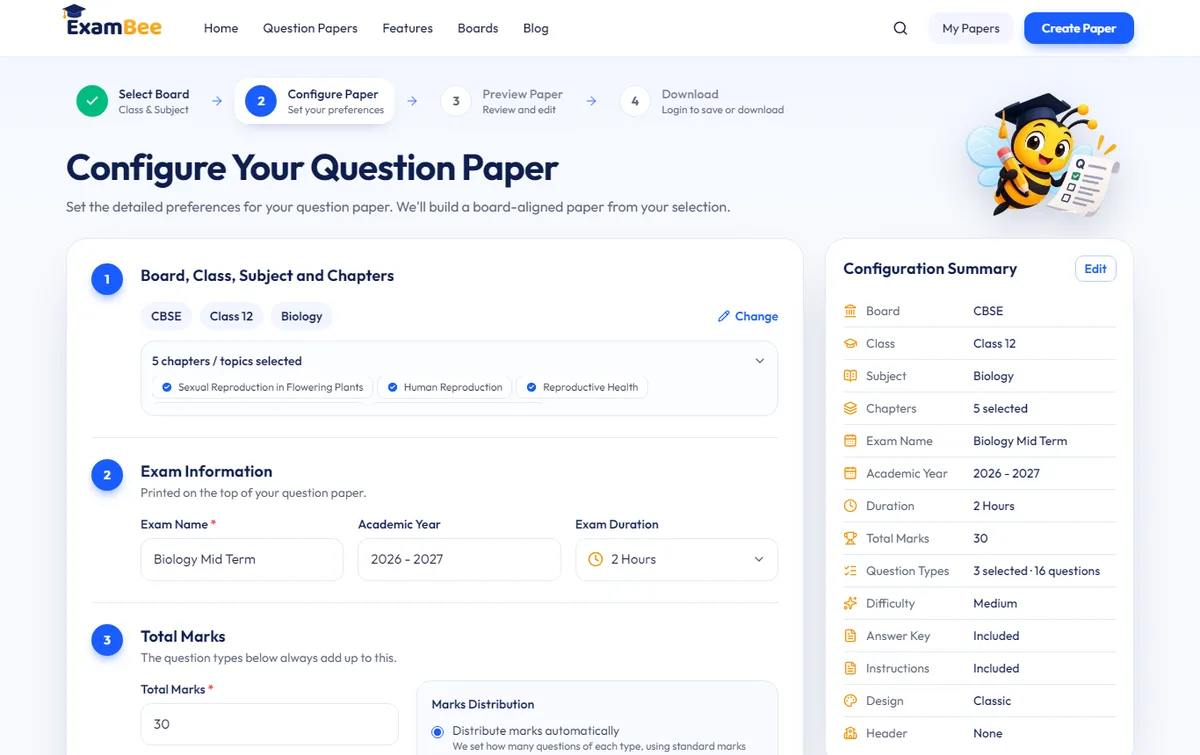
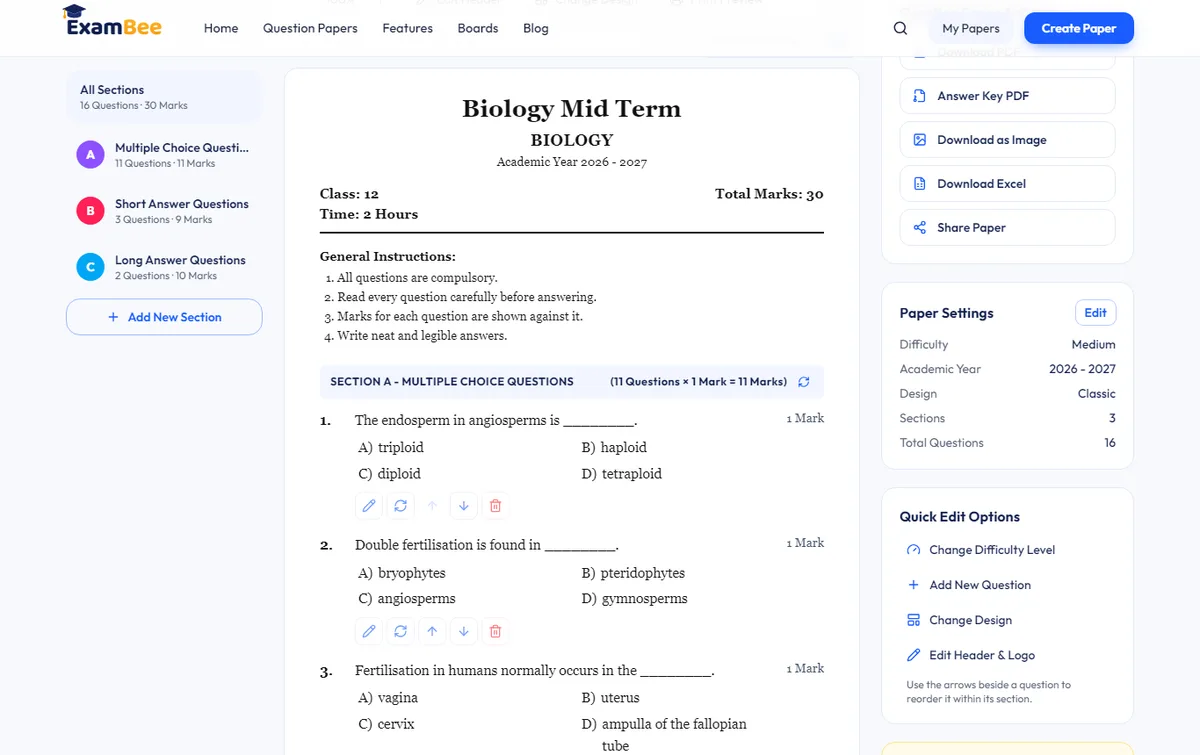
Turning a blueprint into a paper with ExamBee
- 1
Chapters = coverage
Pick the board, class, subject and the chapters your blueprint covers.
- 2
Types × marks = sections
Enter the total, then the number and marks of each question type - ExamBee checks they add up.
- 3
Difficulty = mix
Choose easy, medium, hard or mixed; generate, then swap any question that doesn't fit the blueprint.
A blueprint template you can copy
Most school tests fit one simple template. Fill in the chapters in the first column, then spread the questions across the question types so that each row adds up to the marks you planned for that chapter and each column adds up to the marks for that question type. The example below is for a 40-mark unit test with four chapters; change the chapter names and numbers to suit your class.
| Chapter | MCQ (1) | Fill / T-F (1) | Short (3) | Long (5) | Total |
|---|---|---|---|---|---|
| Chapter 1 | 4 | 1 | 1 | 1 | 13 |
| Chapter 2 | 3 | 1 | 2 | 0 | 10 |
| Chapter 3 | 3 | 1 | 1 | 0 | 7 |
| Chapter 4 | 2 | 1 | 1 | 1 | 10 |
| Total | 12 (12) | 4 (4) | 5 (15) | 2 (10) | 40 marks |
Check the totals both ways before you start choosing questions: the row totals must add up to 40 and so must the column totals. Then mark each planned question as easy, medium or hard so that roughly a third of the marks fall in each band, or a little more on the easy side for younger classes.
Common blueprint mistakes
- Giving the last chapter taught too many marks because it is fresh in mind.
- Putting every long question on the same chapter, so one weak topic decides the grade.
- Planning more questions than students can finish in the time available.
- Forgetting the internal choice, then adding it at the last minute and breaking the balance.
- Writing the blueprint after the paper instead of before it.
If you prefer to skip the arithmetic, enter the marks for each question type on ExamBee and let it pick questions from the chapters you tick. See how it works on the features page.
Checklist before you print
- Do the section marks add up to the total, and is the total printed on the paper?
- Is every chapter in the blueprint represented, with roughly the planned marks?
- Are instructions clear (time, marks, which questions have choice)?
- Is the difficulty mix sensible - an easy start, and no more than about a quarter hard?
- Is the answer key complete and checked for every question?
- Is the school name, class, subject and exam name correct in the header?
Common blueprint mistakes
- Giving every chapter equal marks even though some took three times longer to teach.
- Too many long answers in a short test - students run out of time, not knowledge.
- Only 'remember' questions - the paper rewards memorising, not understanding.
- Forgetting to check that the sections add up to the total (ExamBee does this for you).
See blueprints applied to real subjects in our guides for CBSE Class 12 Physics, Class 12 Commerce and Class 1-4 unit tests, ICSE Class 9-10 Science and Hindi and Marathi grammar tests. Browse boards on the boards page, or go straight to the question paper generator. Everything the generator can do is on the features page.
Frequently asked questions
What is a question paper blueprint?+
A blueprint is a plan for a question paper: how many marks go to each chapter or unit, which question types are used, and how the questions are spread across difficulty and thinking levels. It is made before any question is chosen.
What is a good difficulty mix for a school test?+
A common starting point is about 30% easy, 50% medium and 20% hard questions by marks. Adjust it for the class and the purpose of the test.
How do I decide marks per chapter?+
In proportion to teaching time and board weightage. If the board gives a unit 16 of 70 marks, it should get roughly the same share in your mock paper.
Does ExamBee follow my blueprint?+
Yes. You set the total marks and how many questions of each type, with marks per question, and choose the chapters and difficulty. ExamBee checks that the sections add up exactly to your total before building the paper.
What are Bloom's taxonomy levels in a question paper?+
They classify questions by thinking skill: remember, understand, apply, analyse, evaluate and create. A balanced paper has more of the lower levels for younger classes and more application and analysis for senior classes.
How many questions should a 40-mark paper have?+
Usually 20 to 25: around 15 one-mark objective questions, five 3-mark short answers and two 5-mark long answers. Adjust for the class and the time available.
Is a blueprint the same as a marking scheme?+
No. The blueprint plans which questions go into the paper and how many marks each part of the syllabus gets; the marking scheme says how marks are awarded within each answer.
Should every chapter get equal marks?+
Not usually. Give chapters marks in proportion to teaching time and their board weightage, so longer and more important chapters carry more marks.
How do I make a paper harder without making it longer?+
Replace some recall questions with application and analysis questions, and raise the share of hard questions slightly - keep the same total marks and number of questions.