
Class 12 Physics is the subject many students fear and many teachers love to teach. It is also one of the most rewarding to test well: a good unit test tells you within an hour whether a class really understands Gauss's law, or has only memorised the formula. This guide walks through every chapter of the CBSE Class 12 Physics syllabus (NCERT), explains what each chapter is really about, shows the kind of questions that work for each, and ends with a simple plan for building chapter-wise tests and full mock papers.
If you just want to make a paper now, open the CBSE Class 12 Physics question paper generator, tick the chapters you have finished and set your marks - the paper and its answer key are ready in a few minutes.
CBSE Class 12 Physics syllabus at a glance
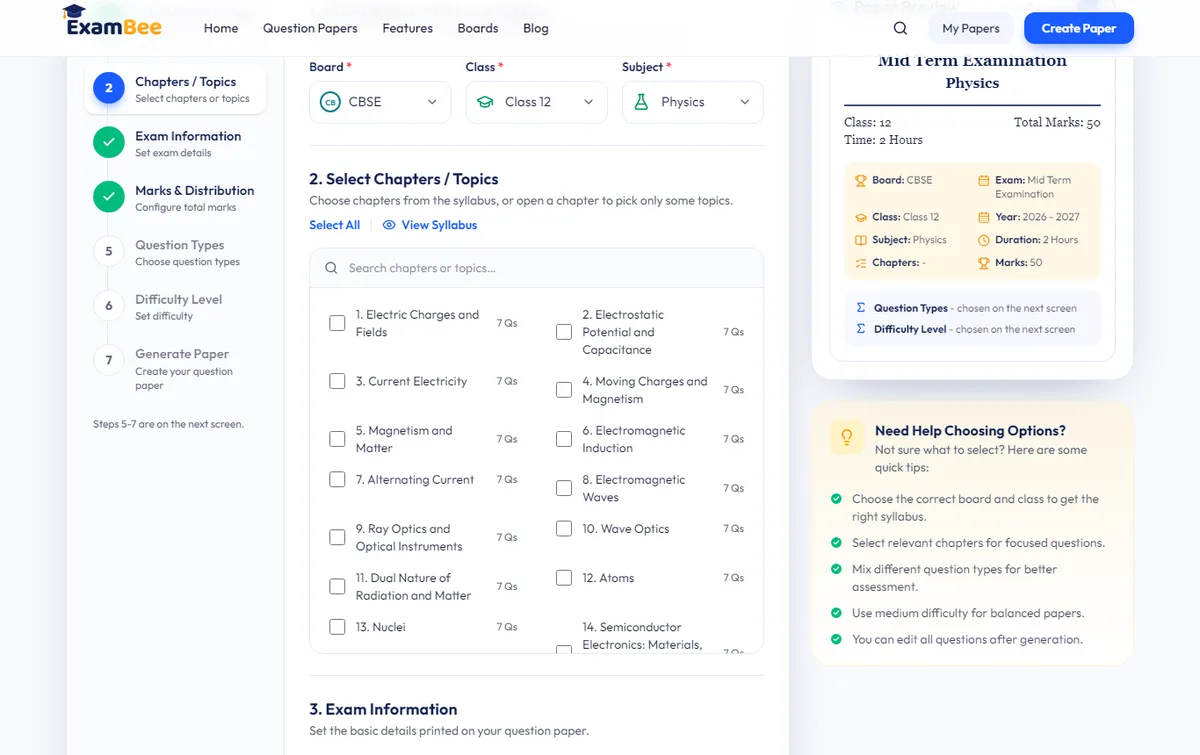
The NCERT textbook comes in two parts. Part I covers electricity and magnetism (chapters 1-8), and Part II covers optics and modern physics (chapters 9-14). Here is the full chapter list with what each one covers:
| No. | Chapter | Main topics |
|---|---|---|
| 1 | Electric Charges and Fields | Coulomb's law, electric field, field lines, dipole, Gauss's law and its applications |
| 2 | Electrostatic Potential and Capacitance | Potential, equipotential surfaces, potential energy, capacitors, dielectrics, energy stored |
| 3 | Current Electricity | Drift velocity, Ohm's law, resistivity, cells and emf, Kirchhoff's rules, Wheatstone bridge |
| 4 | Moving Charges and Magnetism | Lorentz force, Biot-Savart law, Ampere's law, solenoid, torque on a loop, galvanometer |
| 5 | Magnetism and Matter | Bar magnet as a dipole, magnetic field lines, para-, dia- and ferromagnetism |
| 6 | Electromagnetic Induction | Faraday's and Lenz's laws, motional emf, eddy currents, self and mutual inductance |
| 7 | Alternating Current | rms values, phasors, LCR circuit, resonance, power factor, transformer |
| 8 | Electromagnetic Waves | Displacement current, nature of EM waves, the electromagnetic spectrum |
| 9 | Ray Optics and Optical Instruments | Mirrors, refraction, TIR, lenses, prism, microscope and telescope |
| 10 | Wave Optics | Huygens' principle, interference (YDSE), diffraction, polarisation |
| 11 | Dual Nature of Radiation and Matter | Photoelectric effect, Einstein's equation, de Broglie waves |
| 12 | Atoms | Rutherford's model, Bohr's model, hydrogen spectrum |
| 13 | Nuclei | Composition, mass defect, binding energy curve, fission and fusion |
| 14 | Semiconductor Electronics: Materials, Devices and Simple Circuits | Intrinsic/extrinsic semiconductors, p-n junction, diode as rectifier |
Exam pattern and marks distribution
The board exam has a 70-mark theory paper and 30 marks of practicals (experiments, activities, project and viva). The theory paper is 3 hours long and mixes objective questions (MCQs, assertion-reason), very short and short answers, case-based questions and long answers. Two unit weightages from the 2025-26 curriculum are worth knowing because they shape how you plan tests:
- Electrostatics (Ch 1-2)16 marks
- Electronic Devices (Ch 14)7 marks
Source: CBSE 2025-26 curriculum as reported by education portals. Check cbseacademic.nic.in for the complete, current table.
Electrostatics alone is close to a quarter of the theory paper, so it deserves at least two full chapter tests. Semiconductor electronics is a smaller unit but very scoring, because its questions are predictable: diode characteristics, rectifiers and the difference between n-type and p-type material.
Chapter-by-chapter guide with test ideas
1. Electric Charges and Fields
The chapter starts with properties of charge (quantisation, conservation, additivity) and Coulomb's law, then builds the idea of the electric field and field lines. The heart of the chapter is Gauss's law. Good test questions ask students to apply it to an infinite wire, an infinite plane sheet and a thin spherical shell, and to explain why field lines never cross. Numericals on the force between two charges and the field of a dipole on its axis and equatorial line are standard.
Q1.Short answerTwo point charges of 2 μC and 3 μC are 30 cm apart in air. Find the force between them.
Answer: F = kq1q2/r² = 9×10⁹ × 2×10⁻⁶ × 3×10⁻⁶ / 0.09 = 0.6 N (repulsive).
2. Electrostatic Potential and Capacitance
Potential is work per unit charge, and equipotential surfaces are always perpendicular to field lines - a favourite one-mark idea. The second half covers capacitors: combinations in series and parallel, the parallel-plate capacitor, the effect of a dielectric (C becomes K times larger) and energy stored. Include at least one derivation (capacitance of a parallel-plate capacitor) and one combination numerical in every test on this chapter.
Q2.Short answerThree capacitors of 2 μF, 3 μF and 6 μF are connected in series. Find the equivalent capacitance.
Answer: 1/C = 1/2 + 1/3 + 1/6 = 1, so C = 1 μF.
3. Current Electricity
A long, numerical-heavy chapter. Students must connect the microscopic picture (drift velocity, I = neAv_d, mobility) with the macroscopic one (Ohm's law, resistivity). Kirchhoff's rules and the Wheatstone bridge give excellent 3-mark problems. Ask about temperature dependence of resistance (metals vs semiconductors) and internal resistance of cells - students often confuse terminal voltage with emf.
Q3.Short answerA cell of emf 2 V and internal resistance 0.5 Ω is connected to a 3.5 Ω resistor. Find the current and the terminal voltage.
Answer: I = E/(R + r) = 2/4 = 0.5 A; terminal voltage V = E - Ir = 2 - 0.25 = 1.75 V.
4. Moving Charges and Magnetism
From the Lorentz force to the moving coil galvanometer, this chapter rewards students who can draw. Questions on the circular motion of a charge in a magnetic field, the field of a long wire using Ampere's law, and the force between parallel currents (and the definition of the ampere) appear year after year. The conversion of a galvanometer into an ammeter or voltmeter is a reliable short-answer question.
5. Magnetism and Matter
A shorter, more conceptual chapter: the bar magnet as an equivalent solenoid, magnetic field lines, and the classification of materials into diamagnetic, paramagnetic and ferromagnetic. Tables comparing the three types make great 3-mark questions, and the Curie temperature is a common one-liner.
6. Electromagnetic Induction
Faraday's law and Lenz's law (and why Lenz's law follows from conservation of energy) are the core. Motional emf in a rod moving through a field is the standard long-answer derivation, often extended to the force needed to keep the rod moving and the power dissipated. Eddy currents and self/mutual inductance round off the chapter.
Q4.Long answerDerive the expression for the motional emf induced in a rod of length l moving with velocity v perpendicular to a uniform magnetic field, and find the power needed to keep it moving if the circuit resistance is R.
Answer: Flux Φ = Blx, so e = dΦ/dt = Blv. Current I = Blv/R; the force on the rod is BIl = B²l²v/R, and the power needed is P = Fv = B²l²v²/R, which equals the Joule heating I²R.
7. Alternating Current
Students meet phasors for the first time here. A good test checks rms values, the phase relationship in pure R, L and C circuits, the impedance of a series LCR circuit, resonance and power factor. The transformer (and why it cannot work on DC) is a guaranteed short answer.
8. Electromagnetic Waves
A small but conceptual chapter: Maxwell's displacement current, the transverse nature of EM waves, and the electromagnetic spectrum with uses of each band. One table question - "arrange in order of increasing frequency and give one use of each" - covers most of it.
9. Ray Optics and Optical Instruments
One of the longest and highest-scoring chapters. Mirror and lens formulas, refraction at spherical surfaces, total internal reflection (with optical fibres as the application), lens maker's formula, prisms and dispersion, and finally the microscope and telescope. Ray diagrams carry marks, so include at least one diagram-based question per test.
Q5.Short answerAn object is placed 30 cm in front of a convex lens of focal length 20 cm. Find the position of the image and the magnification.
Answer: 1/v - 1/u = 1/f gives 1/v = 1/20 - 1/30 = 1/60, so v = 60 cm (real image); m = v/u = -2 (inverted, twice the size).
10. Wave Optics
Huygens' principle (and using it to prove Snell's law), Young's double-slit experiment with the fringe-width formula, single-slit diffraction and polarisation (Brewster's law, Polaroids). The fringe-width numerical is quick to set and quick to mark.
11. Dual Nature of Radiation and Matter
The photoelectric effect is where students see why the wave theory of light failed. Einstein's equation explains the threshold frequency, the dependence of maximum kinetic energy on frequency (not intensity) and instantaneous emission. De Broglie wavelength numericals finish the chapter.
Q6.True / FalseThe maximum kinetic energy of photoelectrons increases with the intensity of incident light.
Answer: False - the maximum kinetic energy depends on frequency, not intensity.
12. Atoms
Rutherford's alpha-scattering experiment and its conclusions, the limitations of his model, and Bohr's postulates leading to the radius and energy of the nth orbit. The hydrogen spectrum (Lyman, Balmer, Paschen series) gives easy one-mark questions.
13. Nuclei
Mass defect and binding energy, the binding-energy-per-nucleon curve and what it says about fission and fusion, and the nature of nuclear forces. Ask students to sketch the curve and use it to explain why both processes release energy - a classic 5-mark question.
14. Semiconductor Electronics
Energy bands, intrinsic and extrinsic semiconductors, the p-n junction (depletion region, barrier potential), diode in forward and reverse bias, and the half-wave and full-wave rectifier. A small chapter with a high return on revision time.
Important derivations to practise
Derivations are where many students lose easy marks - they know the result but skip steps, forget the diagram or mix up the assumptions. The list below covers the derivations that appear most often in CBSE Class 12 Physics papers. Put at least one of them into every unit test until students can write them without notes.
| Chapter | Derivation |
|---|---|
| Electric Charges and Fields | Field due to a dipole on the axial and equatorial line; field of an infinite wire, plane sheet and spherical shell using Gauss's law |
| Potential and Capacitance | Potential due to a dipole; capacitance of a parallel-plate capacitor with and without a dielectric; energy stored in a capacitor |
| Current Electricity | Relation between current and drift velocity; Ohm's law from drift velocity; balance condition of a Wheatstone bridge |
| Moving Charges and Magnetism | Field at the centre of a circular loop; field of a long solenoid; force between two parallel currents; torque on a current loop |
| Electromagnetic Induction | Motional emf; self-inductance of a long solenoid; mutual inductance of two coaxial solenoids |
| Alternating Current | Impedance of a series LCR circuit; resonant frequency; average power in an AC circuit |
| Ray Optics | Mirror formula; refraction at a spherical surface; lens maker's formula; magnifying power of microscope and telescope |
| Wave Optics | Laws of reflection and refraction from Huygens' principle; fringe width in Young's experiment |
| Atoms | Radius and energy of the nth Bohr orbit |
A good way to test a derivation is to split it: one short-answer question asks for the setup and assumptions, and a long-answer question asks for the full result and one application. That way students who understand the idea but slip on the algebra still earn part marks, which is exactly how board examiners mark.
Common mistakes students make in Class 12 Physics
- Mixing up units and prefixes. μC, nC and pC errors ruin otherwise correct electrostatics numericals. Ask students to write SI units at every step.
- Sign conventions in optics. Distances measured against the incident light are negative. Most wrong lens and mirror answers come from a missing minus sign.
- Confusing emf and terminal voltage. The terminal voltage of a cell is less than its emf while it supplies current.
- Thinking magnetic force does work. The force on a moving charge is perpendicular to its velocity, so it changes direction, not speed.
- Photoelectric effect and intensity. Intensity changes the number of photoelectrons, not their maximum kinetic energy.
- Unlabelled diagrams. Ray diagrams and circuit diagrams without arrows, labels or directions lose marks even when the answer is right.
ExamBee's true-or-false questions are written to catch these misconceptions. Every Class 12 Physics chapter has at least one false statement students must spot, such as "the maximum kinetic energy of photoelectrons increases with the intensity of light".
Practicals: 30 marks you should not ignore
The practical component carries 30 marks - more than any single unit of the theory paper. It usually includes two experiments, a practical record, an activity or project and a viva. The viva is where the theory you test in class pays off: students who can explain why a potentiometer is preferred over a voltmeter, or how the focal length of a convex lens is found from the u-v graph, score well. Short MCQ and one-word quizzes from ExamBee make good viva preparation in the last two weeks before practicals - pick the chapters behind the experiments (Current Electricity, Ray Optics, Semiconductor Electronics) and generate a quick 15-question quiz.
Competency-based and case-based questions
CBSE now expects a good share of competency-based questions - questions that put a concept in a real situation and ask students to apply it. In Physics these often look like a short passage about a real device (a hydraulic lift, a solar cell, an optical fibre, a transformer at a power station) followed by three or four questions on it. The physics is the same as in the chapter; what changes is that students must recognise which law applies.
You can prepare students for this with ordinary chapter tests: use the application-style short answers (for example, why a fuse or transformer behaves a certain way, or why the Sun appears red at sunset) and ask students to name the principle before they calculate. When you set a full mock, include one or two of your own case passages using "Add question" on the paper page, and let the generator fill the rest of the paper.
Which question types work best
A balanced Class 12 Physics test mixes recall, application and derivation. In ExamBee each chapter has five types of questions, so you can mirror the board pattern in a short test:
- MCQs (1 mark) - quick checks of laws, units and definitions.
- Fill in the blanks and true/false (1 mark) - catch common misconceptions (for example, that magnetic force does work on a moving charge).
- Short answers (3 marks) - short derivations and numericals.
- Long answers (5 marks) - full derivations and multi-step problems.

Not sure how many questions of each type to use? Our guide to building a question paper blueprint shows worked blueprints for Class 10 and Class 12.
Make a chapter-wise Physics test in 3 steps
- 1
Pick the chapters
Open the generator with CBSE, Class 12 and Physics selected, then tick the chapters you have taught - one or several.
- 2
Set the paper
Enter the exam name and total marks, then choose how many MCQs, short and long answers you want.
- 3
Generate and print
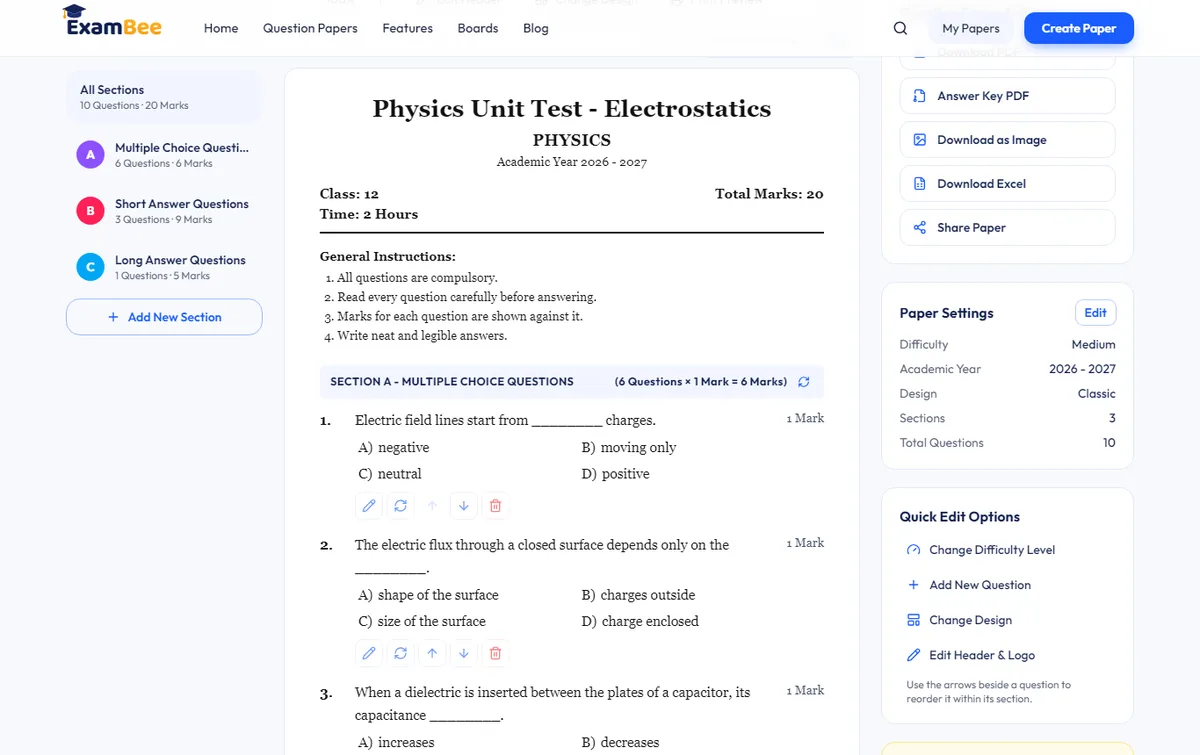
Log in with Google or email, generate, check the paper and answer key, swap any question, then download the PDF.
Tips for better Physics tests
- Test Electrostatics and Current Electricity twice - they are long and carry many marks.
- Keep at least one derivation in every paper; derivations are where marks are lost in the board exam.
- Use 'Regenerate' on one section to make a second version of the same test for another class.
- Mix difficulty: start with easy MCQs so weaker students settle in, then move to numericals.
An 8-week revision plan with weekly tests
| Week | Chapters | Test idea |
|---|---|---|
| 1 | 1-2 Electrostatics | 20-mark unit test with one derivation |
| 2 | 3 Current Electricity | Numericals-heavy 20-mark test |
| 3 | 4-5 Magnetism | Diagram and derivation focus |
| 4 | 6-8 EMI, AC, EM waves | Mixed 25-mark test |
| 5 | 9 Ray Optics | Ray diagrams + lens/mirror numericals |
| 6 | 10-11 Wave Optics, Dual Nature | Concept MCQs + YDSE numericals |
| 7 | 12-14 Atoms, Nuclei, Semiconductors | Short-answer heavy test |
| 8 | All chapters | Full 70-mark mock paper |
For the final mock, tick all 14 chapters and set 70 marks. Because ExamBee picks fresh questions each time, you can generate a second mock for the week before the exam. Find more resources on the CBSE Class 12 Physics page and the CBSE question paper generator. Teaching Chemistry or Biology too? Read our Class 11-12 Chemistry and Biology guide. ISC teachers can start from the ISC Class 12 Physics generator, Maharashtra HSC teachers from the Maharashtra Board Class 12 Physics generator, and Class 11 teachers from CBSE Class 11 Physics. See everything the generator can do on the features page.
Frequently asked questions
How many chapters are there in CBSE Class 12 Physics?+
The NCERT Class 12 Physics textbook (Parts I and II) has 14 chapters, from Electric Charges and Fields to Semiconductor Electronics. ExamBee lists all 14 for CBSE Class 12 Physics.
What is the marks distribution of the CBSE Class 12 Physics exam?+
The theory paper carries 70 marks and practicals 30 marks. Electrostatics (chapters 1-2) carries 16 marks and Electronic Devices (chapter 14) 7 marks in the 2025-26 curriculum. Always confirm the latest figures on cbseacademic.nic.in.
Can I make a chapter-wise Physics test with ExamBee?+
Yes. Choose CBSE, Class 12 and Physics, tick one or more chapters, set the marks and question types, and ExamBee builds the paper with an answer key. It is free with an ExamBee account.
Does ExamBee include long answer (5-mark) Physics questions?+
Yes. Every Class 12 Physics chapter has multiple choice, fill in the blank, true or false, short answer (3 marks) and long answer (5 marks) questions, each with a model answer.
Can ISC and Maharashtra HSC teachers use these Physics chapters?+
Yes. ExamBee offers Class 12 Physics for ICSE (ISC) and Maharashtra State Board too, organised by the same core topics, since the syllabi cover largely the same physics.