
ICSE students write three separate Science papers - Physics, Chemistry and Biology - and the board is known for questions that test application, not just recall. That makes chapter-wise practice tests the single most useful thing a teacher can give in Classes 9 and 10. This guide covers every chapter of the CISCE Physics, Chemistry and Biology syllabus, what each chapter is about, sample questions with answers, and a plan for testing through the year up to the pre-boards.
Start a paper now: ICSE Class 10 Physics, Chemistry or Biology, or the Class 9 versions of Physics, Chemistry and Biology.
How the ICSE Science papers are structured
In ICSE Class 10, Science is examined as three papers: Physics, Chemistry and Biology. Each paper has typically carried 80 marks for the written exam plus 20 marks of internal assessment (practical work and projects). The written paper has usually been in two sections: a compulsory first section of short, objective and application questions across the whole syllabus, and a second section where students answer a choice of longer, structured questions. CISCE revises the format from time to time, so always check the latest specimen paper on cisce.org before setting a pre-board.
What this means for school tests: the compulsory section rewards breadth, so frequent short quizzes across many chapters matter; the structured section rewards depth, so each chapter also needs at least one test with long answers. ExamBee lets you do both from the same bank - an MCQ-heavy quiz across six chapters one week, a long-answer test on two chapters the next.
ICSE Physics: Class 9 and Class 10
| Class 9 Physics | Class 10 Physics |
|---|---|
| Measurements and Experimentation | Force |
| Motion in One Dimension | Work, Energy and Power |
| Laws of Motion | Machines |
| Pressure in Fluids and Atmospheric Pressure | Refraction of Light at Plane Surfaces |
| Upthrust in Fluids, Archimedes' Principle and Floatation | Refraction through a Lens |
| Heat and Energy | Spectrum |
| Reflection of Light | Sound |
| Propagation of Sound Waves | Current Electricity |
| Current Electricity | Household Circuits |
| Magnetism | Electro-Magnetism |
| Calorimetry | |
| Radioactivity |
What to focus on in Physics
Class 9 builds the toolkit: measurement (vernier callipers, screw gauge, simple pendulum), motion graphs, Newton's laws, fluid pressure and floatation. Class 10 is where the board marks are: moments and the principle of moments, machines (mechanical advantage, velocity ratio, efficiency and pulley systems), lenses with ray diagrams, current electricity numericals, calorimetry and radioactivity. Machines and calorimetry produce some of the most predictable numericals in the paper, so practise them until they are automatic.
Q1.Short answerA lever has a load arm of 10 cm and an effort arm of 50 cm. Find its mechanical advantage.
Answer: MA = effort arm / load arm = 50 / 10 = 5.
Q2.Long answer100 g of water at 80 °C is mixed with 100 g of water at 20 °C. Find the final temperature and state the principle used.
Answer: Heat lost by hot water = heat gained by cold water: 100 × c × (80 - T) = 100 × c × (T - 20), so T = 50 °C (principle of calorimetry, assuming no heat loss).
Q3.True / FalseA fuse is connected in the neutral wire.
Answer: False - a fuse is always connected in the live wire, so the appliance is disconnected from the supply when it melts.
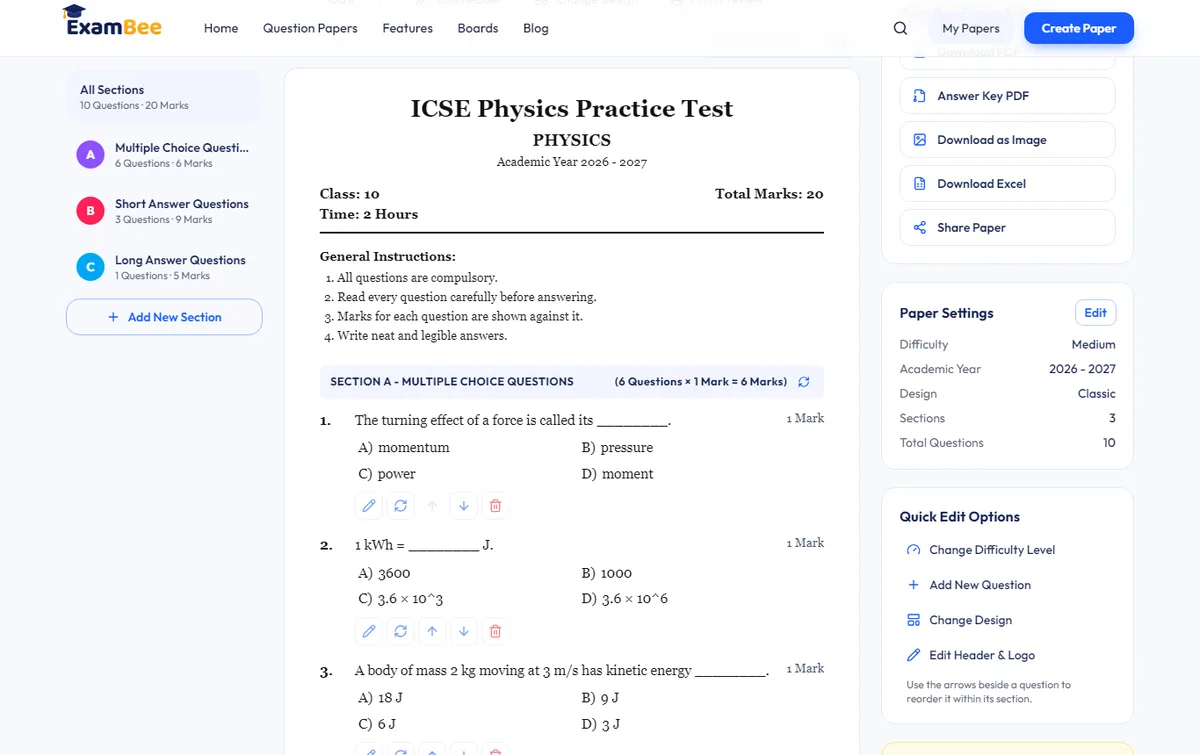
Class 10 Physics chapter highlights
- Force - moment of a force, couple, principle of moments, centre of gravity, uniform circular motion and centripetal force.
- Work, Energy and Power - work done by a force, kinetic and potential energy, conservation of energy, power and its units including kWh.
- Machines - mechanical advantage, velocity ratio, efficiency, the three classes of levers, single and block-and-tackle pulley systems.
- Refraction at plane surfaces - laws of refraction, refractive index, real and apparent depth, critical angle and total internal reflection.
- Refraction through a lens - convex and concave lenses, ray diagrams, lens formula, magnification and power.
- Spectrum - dispersion through a prism, the electromagnetic spectrum, properties and uses of infrared and ultraviolet, scattering of light.
- Sound - echoes, natural, damped and forced vibrations, resonance, and the characteristics of sound (loudness, pitch, quality).
- Current Electricity - Ohm's law, resistance in series and parallel, emf and internal resistance, electrical energy and power.
- Household Circuits - ring system, fuses and MCBs, earthing, three-pin plugs and colour coding of wires.
- Electro-Magnetism - magnetic effect of current, electromagnets, DC motor, electromagnetic induction, AC generator and transformer.
- Calorimetry - heat capacity, specific heat capacity, latent heat and the principle of mixtures.
- Radioactivity - alpha, beta and gamma radiations, changes in the nucleus, nuclear fission and fusion, and safety precautions.
ICSE Chemistry: Class 9 and Class 10
| Class 9 Chemistry | Class 10 Chemistry |
|---|---|
| The Language of Chemistry | Periodic Table, Periodic Properties and Variations |
| Chemical Changes and Reactions | Chemical Bonding |
| Water | Acids, Bases and Salts |
| Atomic Structure and Chemical Bonding | Analytical Chemistry |
| The Periodic Table | Mole Concept and Stoichiometry |
| Study of the First Element - Hydrogen | Electrolysis |
| Study of Gas Laws | Metallurgy |
| Atmospheric Pollution | Study of Compounds - Hydrogen Chloride |
| Study of Compounds - Ammonia | |
| Study of Compounds - Nitric Acid | |
| Study of Compounds - Sulphuric Acid | |
| Organic Chemistry |
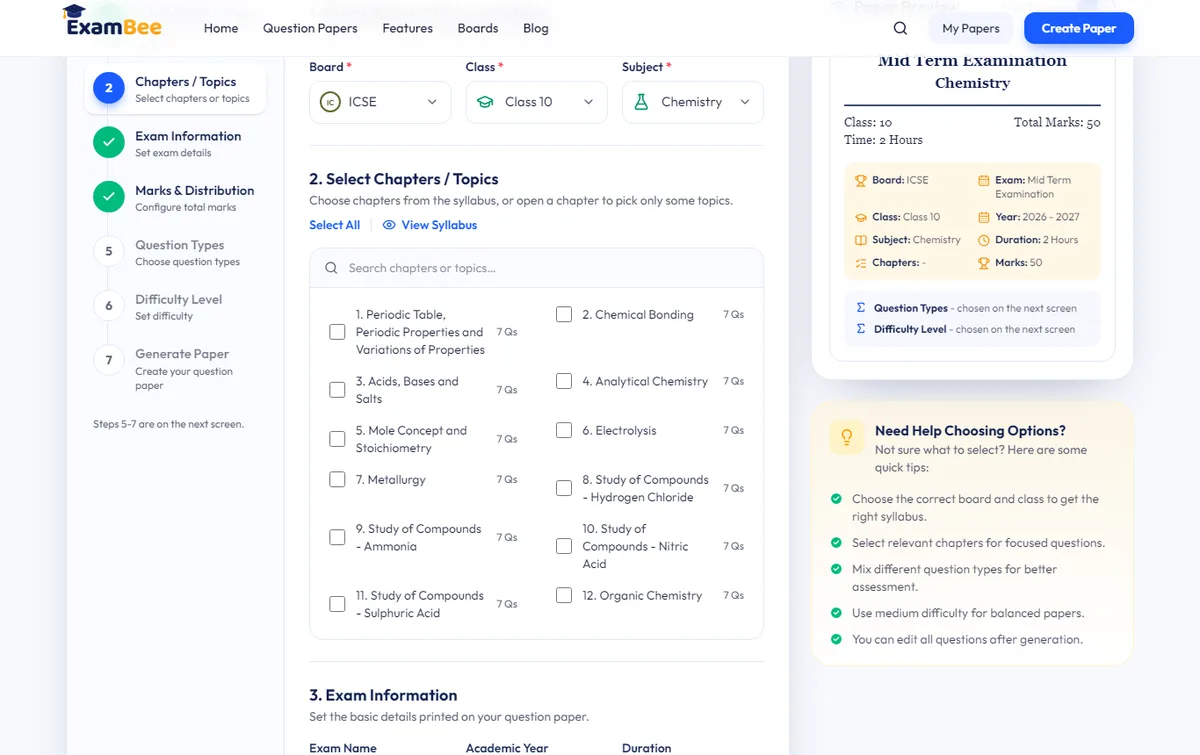
What to focus on in Chemistry
ICSE Chemistry rewards accurate equations and observations. In Class 10, analytical chemistry (colour of precipitates with NaOH and NH₄OH, and whether they dissolve in excess), the mole concept, electrolysis (electrode reactions, electroplating) and the industrial processes - Haber, Ostwald and Contact - come up every year. The four "study of compounds" chapters follow one pattern: lab preparation, collection and drying, properties and tests, so build tests that ask for all four.
Q4.Short answerHow will you distinguish between solutions of Zn(NO₃)₂ and Pb(NO₃)₂ using ammonium hydroxide?
Answer: With NH₄OH both give white precipitates; Zn(OH)₂ dissolves in excess NH₄OH, Pb(OH)₂ does not.
Q5.Long answerDescribe the steps of the Contact process for the manufacture of sulphuric acid with balanced equations.
Answer: S + O₂ → SO₂; 2SO₂ + O₂ ⇌ 2SO₃ (V₂O₅ catalyst, about 450 °C); SO₃ + H₂SO₄ → H₂S₂O₇ (oleum); H₂S₂O₇ + H₂O → 2H₂SO₄.
Q6.Short answerCalculate the volume of CO₂ at STP obtained when 50 g of calcium carbonate is heated (Ca = 40, C = 12, O = 16).
Answer: 100 g CaCO₃ gives 22.4 L CO₂ at STP, so 50 g gives 11.2 L.
Class 10 Chemistry chapter highlights
- Periodic Properties - trends in atomic size, ionisation potential, electron affinity, electronegativity and metallic character across periods and down groups.
- Chemical Bonding - electrovalent, covalent and coordinate bonds, with electron-dot structures of NaCl, H₂O, NH₃, H₃O⁺ and NH₄⁺.
- Acids, Bases and Salts - definitions, pH, types of salts (normal, acid, basic) and methods of preparing soluble and insoluble salts.
- Analytical Chemistry - action of NaOH and NH₄OH on salt solutions, and the amphoteric nature of zinc and lead hydroxides.
- Mole Concept and Stoichiometry - Gay-Lussac's law, Avogadro's law, molar volume, percentage composition and calculations from equations.
- Electrolysis - electrolytes, electrode reactions, electrolysis of molten lead bromide, acidified water and copper sulphate, electroplating and refining.
- Metallurgy - ores, concentration, calcination and roasting, the extraction of aluminium (Hall-Heroult), and alloys.
- Study of Compounds - HCl, ammonia, nitric acid and sulphuric acid: laboratory and industrial preparation, properties and tests.
- Organic Chemistry - homologous series, IUPAC naming, isomerism, and the preparation and properties of alkanes, alkenes, alkynes, alcohols and carboxylic acids.
ICSE Biology: Class 9 and Class 10
| Class 9 Biology | Class 10 Biology |
|---|---|
| Cell and Tissues | Cell Cycle, Cell Division and Structure of Chromosomes |
| The Flower, Pollination and Seeds | Genetics - Some Basic Fundamentals |
| Respiration in Plants | Absorption by Roots |
| Five Kingdom Classification and Economic Importance of Bacteria and Fungi | Transpiration |
| Nutrition and the Digestive System | Photosynthesis |
| Movement, Locomotion and Skeleton | Chemical Coordination in Plants |
| Skin - The Jack of All Trades | The Circulatory System |
| The Respiratory System | The Excretory System |
| Hygiene and Diseases | The Nervous System and Sense Organs |
| Waste Generation and Management | The Endocrine System |
| The Reproductive System | |
| Population | |
| Pollution |
Class 10 Biology chapter highlights
- Cell cycle and cell division - interphase, stages of mitosis and meiosis, structure of chromosomes, and the significance of each division.
- Genetics - genes and alleles, dominant and recessive traits, monohybrid crosses, sex determination and sex-linked disorders.
- Absorption by roots and transpiration - osmosis, root pressure, turgor and plasmolysis, stomata and factors affecting transpiration.
- Photosynthesis - the equation, light and dark reactions, and the classic experiments on chlorophyll, light and CO₂.
- Chemical coordination in plants - tropisms and plant hormones (auxins, gibberellins, cytokinins, ethylene, abscisic acid).
- Circulatory system - blood components, structure of the heart, double circulation, blood vessels and lymph.
- Excretory system - kidney and nephron structure, urine formation and osmoregulation.
- Nervous system and sense organs - brain parts, reflex action, the eye and its defects, and the ear.
- Endocrine system - glands, hormones and disorders such as diabetes, goitre and gigantism.
- Reproductive system - male and female systems, menstrual cycle, fertilisation, placenta and development.
- Population and pollution - population growth and its problems, family planning, and air, water, soil and noise pollution with control measures.
What to focus on in Biology
ICSE Biology papers love diagrams and experiments: the experiment to show that chlorophyll is necessary for photosynthesis, the cobalt chloride paper test for transpiration, the structure of the heart, nephron and eye. Genetics questions (monohybrid crosses, genotype vs phenotype) and the human systems in Class 10 carry a lot of marks. Include at least one "describe an experiment" and one labelled-diagram question in every test.
Q7.Long answerDescribe an experiment to show that chlorophyll is necessary for photosynthesis.
Answer: Destarch a variegated plant, expose it to light for a few hours, boil a leaf in water then alcohol, and test with iodine: only the parts that were green turn blue-black, so starch (and photosynthesis) occurs only where chlorophyll is present.
Q8.True / FalseMyopia is corrected using a convex lens.
Answer: False - myopia (short-sightedness) is corrected with a concave lens.
Why Class 9 matters more than it seems
Many ICSE students treat Class 9 as a warm-up, but the Class 10 board paper assumes everything from it. Floatation and Archimedes' principle reappear in Class 10 numericals; the language of chemistry (valency, formulae, balancing) is needed in every Class 10 Chemistry answer; and cell structure, tissues and the human systems from Class 9 Biology are the base for the Class 10 chapters on circulation, excretion and the nervous system. A short Class 9 revision test at the start of Class 10 shows teachers exactly which foundations need repair.
| Subject | Class 9 topics that Class 10 builds on |
|---|---|
| Physics | Measurements and graphs; laws of motion; fluid pressure and floatation; reflection of light; current electricity basics |
| Chemistry | Valency and formulae; balancing equations; atomic structure and bonding; periodic table; gas laws |
| Biology | Cell and tissues; plant respiration; nutrition and digestion; respiratory system; hygiene and diseases |
Class 9 highlights by subject
- Physics 9 - least count and zero error of instruments; distance-time and velocity-time graphs; inertia and momentum; pressure in liquids and the atmosphere; upthrust, relative density and floatation; heat transfer and the greenhouse effect; laws of reflection and images in plane mirrors; echoes and the speed of sound; Ohm's law; magnetic field lines.
- Chemistry 9 - symbols, valency and formulae; balancing equations; types of chemical change; hard and soft water; atomic structure with electronic configuration; the modern periodic table; laboratory preparation of hydrogen; Boyle's and Charles' laws; acid rain, ozone depletion and global warming.
- Biology 9 - plant and animal cells and tissues; the flower, pollination, fertilisation and seed germination; respiration in plants; five-kingdom classification and useful and harmful microbes; digestion; the skeleton and joints; the skin; the respiratory system; hygiene, diseases and vaccination; waste management.
A Class 9 unit test is a good place to build the ICSE habit of precise answers: units in Physics, balanced equations in Chemistry and labelled diagrams in Biology. Students who learn this in Class 9 arrive in Class 10 ready for the board style.
Numericals to practise until they are automatic
- Physics 9: motion graphs and equations of motion; pressure at a depth (P = hρg); upthrust and relative density.
- Physics 10: moments and the principle of moments; mechanical advantage, velocity ratio and efficiency of pulley systems; power of a lens; equivalent resistance; electrical energy and cost in kWh; heat lost = heat gained in calorimetry.
- Chemistry 9: gas law problems (Boyle's, Charles' and the combined gas equation at STP).
- Chemistry 10: mole concept, percentage composition, empirical formula, volume of gases at STP and stoichiometry from equations.
Q9.Short answerA gas occupies 500 mL at 2 atm. Find its volume at 1 atm at the same temperature.
Answer: P1V1 = P2V2 → 2 × 500 = 1 × V2, so V2 = 1000 mL.
Q10.Short answerA 1000 W heater is used for 2 hours a day for 30 days. Find the energy consumed and its cost at ₹5 per unit.
Answer: Energy = 1 kW × 2 h × 30 = 60 kWh; cost = 60 × ₹5 = ₹300.
Experiments and diagrams to know
ICSE examiners frequently ask students to describe an experiment, with apparatus, procedure, observation and conclusion. A handy list to test across the year:
- Physics: verifying the principle of moments; finding the time period of a simple pendulum; refraction through a glass slab; verifying Ohm's law; demonstrating resonance with tuning forks.
- Chemistry: laboratory preparation of hydrogen, HCl, ammonia and nitric acid (with collection and drying); electrolysis of copper sulphate with copper electrodes; tests for ions with NaOH and NH₄OH.
- Biology: chlorophyll and light are necessary for photosynthesis; cobalt chloride test for transpiration; germinating seeds give out heat and CO₂; osmosis with a potato osmometer.
Common mistakes in ICSE Science
- Physics: leaving out units, or writing the answer without the formula and substitution step.
- Chemistry: writing names instead of formulae, unbalanced equations, and missing conditions (catalyst, temperature) for industrial processes.
- Chemistry: mixing up which hydroxides dissolve in excess NaOH (zinc and lead do; copper and iron do not).
- Biology: diagrams without labels or with arrows pointing to empty space; confusing arteries and veins.
- All subjects: writing a paragraph where the question asks for "two differences" - a table is clearer and faster to mark.
A weekly routine for Class 10 students
| Day | Activity |
|---|---|
| Mon | Physics: one chapter test (20 marks) - numericals focus |
| Tue | Revise mistakes from Monday using the answer key |
| Wed | Chemistry: one chapter test - equations and observations |
| Thu | Biology: one chapter test with a labelled diagram |
| Fri | Mixed 25-question MCQ quiz across all three subjects |
| Sat | Rewrite every long answer that lost marks this week |
Revising with short chapter tests
Reading notes again feels productive but is one of the weakest ways to revise. Answering questions from memory - and then checking the answers - fixes facts far better. For ICSE Science this means short tests of 15 to 20 marks on one chapter, taken a few days after the chapter is finished and again a few weeks later. Each test should mix one-mark objective questions, two or three short reasoning questions and at least one numerical or diagram question.
Teachers can make these tests on ExamBee by choosing ICSE, the class and the subject, ticking one chapter and setting the marks. Students preparing on their own can do the same and use the answer key to check their work. Browse every ICSE class and subject on the ICSE board page, and see the blueprint guide for how to balance easy, medium and hard questions in each test.
A year plan: chapter tests to pre-boards
- 1
Chapter tests (Jun-Oct)
One 20-25 mark test per chapter or pair of chapters, mixing MCQs, short and long answers.
- 2
Unit tests (Nov-Dec)
Combine 4-5 chapters per subject into 40-mark tests to build stamina.
- 3
Pre-boards (Jan-Feb)
Tick all chapters and set full marks; generate two different versions for two rounds.
Tips for ICSE Science tests
- Ask for balanced equations and observations, not just names - that is how ICSE marks Chemistry.
- In Physics, always ask for units and the formula before the calculation.
- In Biology, add one diagram question per test; students lose easy marks on unlabelled diagrams.
- Use 'Show answer key' on the paper page to check the key before you print it for teachers.
ICSE schools also use ExamBee for Classes 1-4 - see our Class 1-4 unit test guide. For senior classes, read the Class 11-12 Chemistry and Biology guide, and explore everything on the ICSE question paper generator page.
Frequently asked questions
Are Physics, Chemistry and Biology separate subjects in ICSE Class 9 and 10?+
Yes. ICSE students study Science as three papers - Physics, Chemistry and Biology. ExamBee lists them as separate subjects for ICSE Classes 9 and 10 so you can make a paper for each.
How many chapters does ExamBee have for ICSE Class 10 Physics?+
Twelve topic chapters following the CISCE syllabus: Force; Work, Energy and Power; Machines; Refraction at Plane Surfaces; Refraction through a Lens; Spectrum; Sound; Current Electricity; Household Circuits; Electro-Magnetism; Calorimetry; and Radioactivity.
Which ICSE Class 10 Chemistry topics are tested most?+
Mole Concept and Stoichiometry, Analytical Chemistry (reactions with NaOH and NH4OH), Electrolysis, Metallurgy, the Study of Compounds (HCl, ammonia, nitric acid, sulphuric acid) and Organic Chemistry are all important. ExamBee has questions for each.
Can I use ExamBee for ICSE pre-board papers?+
Yes. Tick all chapters of a subject and set the marks you need. ExamBee builds the paper with MCQs, short answers and long answers plus an answer key; you can edit or swap any question before printing.
Does ExamBee have ICSE Class 9-10 Science in Hindi?+
Not yet - ICSE Science questions are in English, which is the medium of the ICSE board exam.
How many marks is each ICSE Science paper?+
Each of Physics, Chemistry and Biology has typically carried 80 marks for the written paper and 20 for internal assessment. Check the latest CISCE specimen papers for the current format.
Should Class 9 ICSE students take chapter tests too?+
Yes. Class 9 topics such as valency, floatation and cell structure are the foundation of Class 10, and short chapter tests in Class 9 make the board year much easier.