
Class 12 Commerce is three very different subjects under one roof. Accountancy is about precise procedure - one wrong entry and the balance sheet does not tally. Business Studies is about clear, structured writing. Economics needs both: diagrams and numericals in Macroeconomics, and data-backed arguments in Indian Economic Development. This guide covers all three for CBSE, ISC and Maharashtra HSC, with chapter lists, marks, worked examples and a plan for regular tests.
Create papers for any chapter in ExamBee: Accountancy, Business Studies and Economics.
CBSE, ISC and Maharashtra HSC: what each board calls it
| Subject area | CBSE | ISC (CISCE) | Maharashtra HSC |
|---|---|---|---|
| Accounting | Accountancy | Accounts | Book-Keeping and Accountancy |
| Business and management | Business Studies | Commerce / Business Studies | Organisation of Commerce and Management (OCM) |
| Economics | Economics (Macro + IED) | Economics | Economics |
The core topics are largely the same across boards: partnership and company accounts, principles and functions of management, national income, money and banking, and the Indian economy. In ExamBee all three boards use the same subject names (Accountancy, Business Studies, Economics) so teachers can find them easily, with chapters organised by these common topics.
Accountancy: 11 chapters
| No. | Chapter |
|---|---|
| 1 | Accounting for Partnership Firms: Fundamentals |
| 2 | Change in Profit Sharing Ratio and Goodwill |
| 3 | Admission of a Partner |
| 4 | Retirement and Death of a Partner |
| 5 | Dissolution of Partnership Firm |
| 6 | Accounting for Share Capital |
| 7 | Issue and Redemption of Debentures |
| 8 | Financial Statements of a Company |
| 9 | Analysis of Financial Statements |
| 10 | Accounting Ratios |
| 11 | Cash Flow Statement |
- Accounting for Partnership Firms36 marks
- Accounting for Companies24 marks
- Project work20 marks
Source: CBSE 2025-26 curriculum as reported by education portals. The remaining theory marks are for Analysis of Financial Statements or Computerised Accounting.
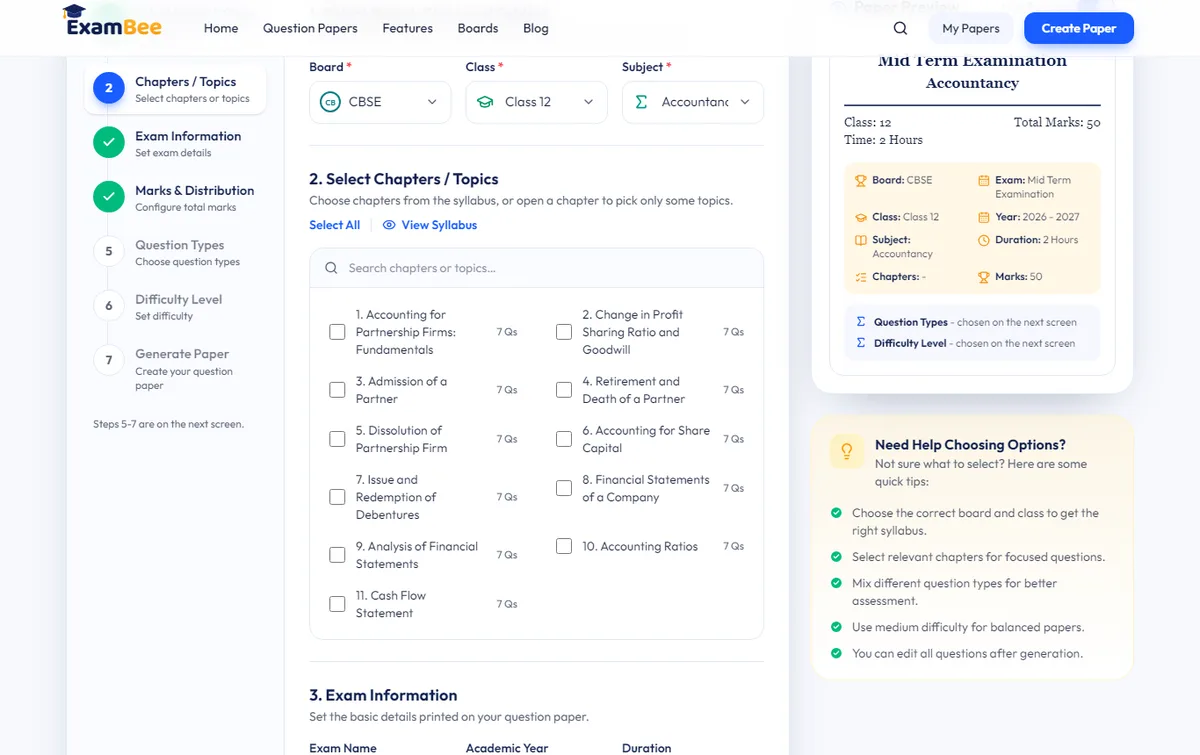
What each Accountancy chapter tests
- Partnership fundamentals - partnership deed and the provisions that apply without one, fixed and fluctuating capital, the profit and loss appropriation account, interest on capital and drawings, and guarantee of profit.
- Change in profit sharing ratio and goodwill - sacrificing and gaining ratios, valuation of goodwill (average profit, super profit, capitalisation), and treatment of reserves and revaluation.
- Admission - new profit-sharing ratio, premium for goodwill brought in cash or not, revaluation account and adjustment of capitals.
- Retirement and death - gaining ratio, goodwill compensation, the deceased partner's share of profit up to death, and the executor's account.
- Dissolution - the realisation account, order of settlement of liabilities, and closing partners' capital accounts.
- Share capital - issue at par and at premium, over- and under-subscription, calls in arrears and advance, forfeiture and reissue.
- Debentures - issue at par, premium and discount, as collateral security, and interest on debentures.
- Company financial statements - the Schedule III balance sheet and statement of profit and loss.
- Analysis, ratios and cash flow - comparative and common-size statements, liquidity, solvency, activity and profitability ratios, and the cash flow statement by the indirect method.
Partnership accounts - the biggest block
Partnership chapters carry the most marks and build on each other: fundamentals (appropriation account, interest on capital and drawings, guarantee of profit), change in profit sharing ratio and goodwill, admission, retirement and death, and dissolution. Every test here should include at least one ratio question (new, sacrificing or gaining ratio) and one adjustment question.
Q1.Short answerA and B share profits 3 : 2. They agree to share equally in future. Find the sacrificing and gaining ratio.
Answer: A sacrifices 3/5 - 1/2 = 1/10; B gains 1/2 - 2/5 = 1/10.
Q2.Short answerA and B share profits 3 : 2. C is admitted for a 1/5 share, which he takes from A and B in their existing ratio. Find the new profit-sharing ratio.
Answer: The remaining 4/5 is shared 3 : 2, so A = 12/25, B = 8/25, C = 5/25. New ratio 12 : 8 : 5.
Company accounts and analysis
Share capital (application, allotment, calls, forfeiture and reissue), debentures, and the Schedule III balance sheet form the company block. Analysis of financial statements, accounting ratios and the cash flow statement test reasoning as much as calculation - ask students to classify items (operating, investing, financing) and to interpret ratios, not just compute them.
Q3.Short answerCurrent assets are ₹2,00,000, current liabilities ₹1,00,000 and inventory ₹50,000. Find the current ratio and quick ratio.
Answer: Current ratio = 2,00,000 / 1,00,000 = 2 : 1. Quick ratio = (2,00,000 - 50,000) / 1,00,000 = 1.5 : 1.
Q4.True / FalseDepreciation is a cash outflow from operating activities.
Answer: False - depreciation is a non-cash expense, added back to net profit in the indirect method.
Business Studies: 12 chapters
The CBSE Business Studies theory paper carries 80 marks, with 20 marks for the project. Part A, Principles and Functions of Management (chapters 1-8), carries 50 marks, and Part B, Business Finance and Marketing (chapters 9-12), carries 30 marks. Nature and Significance of Management alone is listed at 16 marks for the 2025-26 curriculum.
| Part | Chapters |
|---|---|
| A - Principles and Functions of Management (50) | Nature and Significance of Management; Principles of Management; Business Environment; Planning; Organising; Staffing; Directing; Controlling |
| B - Business Finance and Marketing (30) | Financial Management; Financial Markets; Marketing; Consumer Protection |
How to test Business Studies well
- Case-based questions - give a short business situation and ask which principle or function it shows.
- Distinctions - functional vs divisional structure, recruitment vs selection, capital vs money market, marketing vs selling.
- Processes in order - steps in planning, selection, controlling.
- Short recall - Fayol's principles, Maslow's hierarchy, consumer rights.
Q5.MCQ"Father of scientific management" refers to: (a) Henri Fayol (b) F.W. Taylor (c) Peter Drucker (d) Elton Mayo
Answer: (b) F.W. Taylor. Henri Fayol is known for the 14 principles of general management.
Q6.Long answerExplain the steps in the process of controlling.
Answer: Setting performance standards; measuring actual performance; comparing performance with standards; analysing deviations (critical point control, management by exception); taking corrective action.
Economics: Macroeconomics and Indian Economic Development
Since the CBSE restructuring, Class 12 Economics has two parts: Introductory Macroeconomics and Indian Economic Development (IED), each carrying 40 marks, plus a 20-mark project. Class 11 covers Statistics for Economics and Introductory Microeconomics.
- Introductory Macroeconomics40 marks
- Indian Economic Development40 marks
- Project work20 marks
Within Macroeconomics, National Income and Related Aggregates carries 10 marks and Money and Banking 6; within IED, Current Challenges facing the Indian Economy carries 22 marks. Check cbseacademic.nic.in for the full table.
| Part | Chapters in ExamBee |
|---|---|
| Macroeconomics | Introduction to Macroeconomics; National Income Accounting; Money and Banking; Determination of Income and Employment; Government Budget and the Economy; Open Economy Macroeconomics |
| Indian Economic Development | Indian Economy on the Eve of Independence; Indian Economy 1950-1990; Liberalisation, Privatisation and Globalisation; Human Capital Formation; Rural Development; Employment; Environment and Sustainable Development; Comparative Development Experiences of India and its Neighbours |
Q7.Short answerIf MPC = 0.8 and investment increases by ₹100 crore, find the increase in national income.
Answer: k = 1/(1 - MPC) = 1/0.2 = 5; ΔY = 5 × 100 = ₹500 crore.
Q8.Short answerGNP at market price is ₹1,000 crore, depreciation ₹100 crore and net indirect taxes ₹50 crore. Find NNP at factor cost.
Answer: NNP at factor cost = 1,000 - 100 - 50 = ₹850 crore.
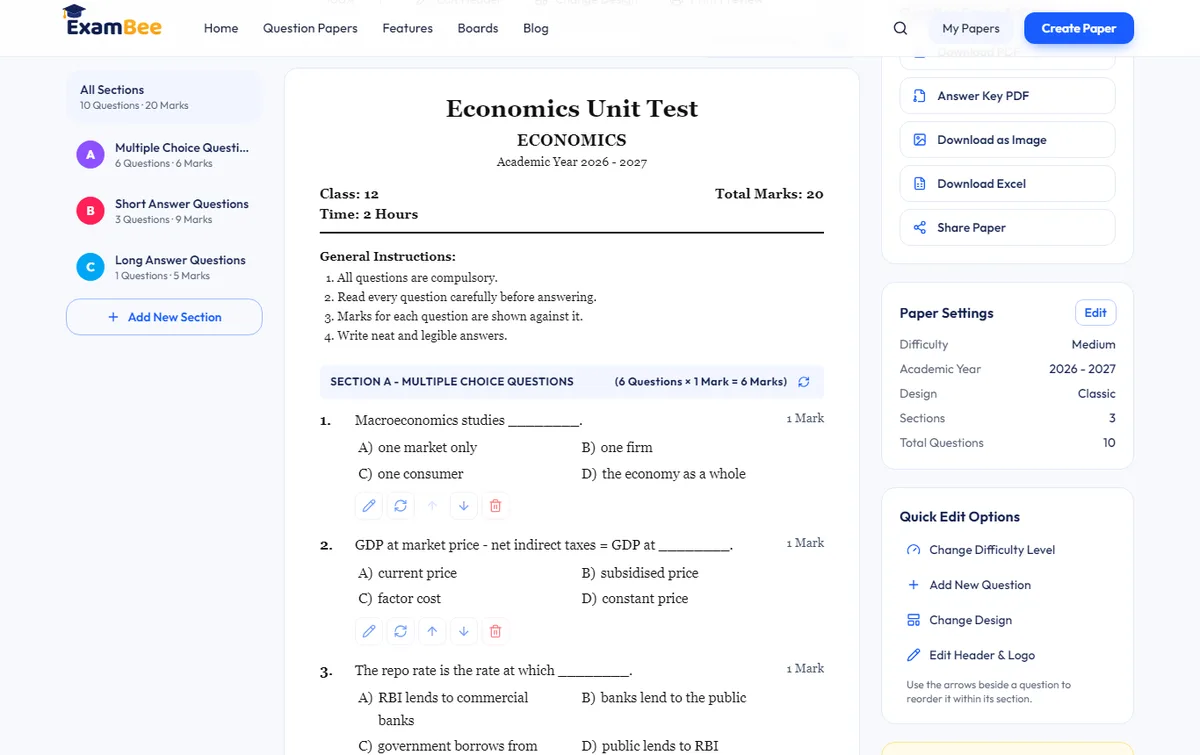
The Class 11 foundation
Class 12 Commerce rests on Class 11. Students who struggle with partnership accounts usually never fully mastered the journal and ledger; students who find Macroeconomics hard often skipped the basics of demand and supply. ExamBee covers Class 11 too, so it is worth giving a short diagnostic test from Class 11 at the start of Class 12.
| Subject | Class 11 chapters in ExamBee |
|---|---|
| Accountancy | Introduction to Accounting; Theory Base; Recording of Transactions I and II; Bank Reconciliation Statement; Trial Balance and Rectification; Depreciation, Provisions and Reserves; Financial Statements I and II |
| Business Studies | Nature and Purpose of Business; Forms of Business Organisation; Public, Private and Global Enterprises; Business Services; Emerging Modes of Business; Social Responsibility and Ethics; Sources of Finance; Small Business; Internal Trade; International Business |
| Economics | Statistics (Introduction; Collection, Organisation and Presentation of Data; Central Tendency; Correlation; Index Numbers) and Microeconomics (Introduction; Consumer Behaviour; Production and Costs; Perfect Competition; Market Equilibrium) |
Class 11 Statistics: a quick win
Statistics for Economics is the most scoring part of Class 11. Its questions are predictable - census vs sample, primary vs secondary data, classification, mean, median and mode, correlation and index numbers - and its numericals are short. A good habit is one 10-15 minute Statistics quiz every week alongside Microeconomics, so students build accuracy with formulas like the arithmetic mean of a frequency distribution and the interpretation of the correlation coefficient (which always lies between -1 and +1).
How Commerce teachers use ExamBee
- Daily 10-question MCQ checks at the start of class, generated in under a minute from the chapter just taught.
- Weekly 25-mark chapter tests with two long answers - for example, an appropriation account and an admission adjustment in Accountancy.
- Two versions of the same test (Regenerate) for two sections, so answers cannot be shared between them.
- Full 80-mark mocks before the boards, with the answer key PDF given to students after the test for self-correction.
Worked example: profit and loss appropriation account
Appropriation questions appear in almost every Class 12 Accountancy paper and are a perfect long-answer question. Here is one from the ExamBee bank, solved step by step:
Question
A and B are partners with capitals of ₹1,00,000 and ₹50,000. The deed allows interest on capital at 10% p.a. and a salary of ₹12,000 to B. Profit before these adjustments is ₹60,000. Partners share profits equally. Prepare the profit and loss appropriation account.
| Particulars | ₹ | Particulars | ₹ |
|---|---|---|---|
| Interest on capital - A | 10,000 | Profit (net profit b/d) | 60,000 |
| Interest on capital - B | 5,000 | ||
| Salary to B | 12,000 | ||
| Profit transferred - A (½) | 16,500 | ||
| Profit transferred - B (½) | 16,500 | ||
| Total | 60,000 | Total | 60,000 |
The key teaching point: interest on capital and partners' salaries are appropriations of profit, not charges against it, so they go in the appropriation account - and only the balance is shared in the profit-sharing ratio.
Writing high-scoring Business Studies answers
Business Studies is marked on content and structure. Students who write in points, with a heading for each point and one line of explanation, consistently score higher than those who write a long paragraph with the same ideas. Teach this format early and use short-answer questions to practise it:
- Start with a one-line definition of the concept.
- Write the points as headings (for example, 'Unity of command'), each with one or two lines of explanation.
- Match the number of points to the marks - five points for a 5-mark answer.
- In case-based questions, quote the line from the case that shows the concept.
- End distinction questions with a small table: basis, first concept, second concept.
Economics diagrams to master
Diagrams carry marks in both Class 11 and Class 12 Economics. A short list to practise: the production possibility curve, demand and supply shifts and market equilibrium, cost curves (AFC, AVC, AC, MC), the consumption and saving functions, aggregate demand and aggregate supply (with deflationary and inflationary gaps), and the circular flow of income. Ask students to label axes and curves - unlabelled diagrams are the most common reason for losing these marks.
Presenting Accountancy answers
Accountancy is marked on format as much as arithmetic. Journal entries need the date, the debit line with "Dr.", the credit line beginning with "To", both amounts, and a short narration in brackets. Ledger accounts need balancing (balance c/d and b/d), and working notes should be shown for every calculated figure such as goodwill, sacrificing ratio or interest on drawings. Teach students to draw the format first and fill in figures second - it prevents most presentation errors and earns step marks even when a calculation slips.
Two Business Studies case studies for practice
Case 1
The production manager of a company asks a supervisor to finish an urgent order. The same evening, the sales manager tells the supervisor to stop that work and pack a different order. The supervisor is confused and both orders are delayed. Which principle of management is violated? Explain it.
Answer: Unity of command - an employee should receive orders from, and be answerable to, only one superior. Orders from two bosses caused confusion and delay.
Case 2
A company first decided its objective of increasing sales by 20%, then studied the market to make assumptions about demand, listed ways to achieve the target, compared them and chose to open new outlets. Which function of management is described? Name the steps shown.
Answer: Planning. Steps: setting objectives, developing premises, identifying alternatives, evaluating alternatives and selecting an alternative (implementation and follow-up come next).
Writing data-based answers in Indian Economic Development
IED questions reward answers that are specific: name the policy, give the year, and say what changed. For example, "The New Economic Policy of 1991 abolished industrial licensing for most industries, reduced import tariffs and opened sectors to foreign investment" scores better than "the government introduced reforms". Train students to answer in three parts - what it is, why it happened, what effect it had - and to compare India with China and Pakistan using a few clear indicators (population growth, sectoral share of GDP, timing of reforms).
The last eight weeks before the boards
| Week | Plan |
|---|---|
| 1-2 | One full-chapter test per day, rotating Accountancy, Business Studies and Economics |
| 3-4 | Unit tests: partnership block, management functions, Macroeconomics, IED |
| 5 | First full mock for each subject (80 marks, timed) |
| 6 | Rework every mistake from the mocks; short MCQ quizzes on weak chapters |
| 7 | Second full mock for each subject - a fresh paper from the generator |
| 8 | Light revision: formats, distinctions, diagrams and definitions only |
Common mistakes in Commerce
- Accountancy: crediting revaluation profit in the new ratio instead of the old ratio; forgetting to adjust accumulated profits on admission or retirement.
- Accountancy: showing debentures under shareholders' funds instead of non-current liabilities in a company balance sheet.
- Business Studies: confusing delegation with decentralisation, and recruitment (positive) with selection (negative).
- Economics: including transfer payments in national income, or confusing real and nominal GDP.
- Economics: stating that the multiplier falls when MPC rises - it rises, since k = 1/(1 - MPC).
Using past papers and sample papers well
Board sample papers and previous years papers show the format, the wording examiners prefer and how marks are split inside a question. They are best used in three passes. First, early in the year, read two or three papers only to understand the pattern - which chapters carry case studies, where the 6-mark questions sit and how much choice is given. Second, after a chapter is taught, pick out only the questions from that chapter and use them as a short test. Third, in the last two months, write complete papers under timed conditions and mark them strictly against the marking scheme.
Past papers alone are not enough, because the same questions repeat in every guide and students start remembering answers instead of thinking. Mix them with fresh questions on the same chapters. On ExamBee you can generate a new chapter paper in a minute, and browse ready papers on the question papers page. For a board-wise view of subjects and classes, start from the CBSE board page.
- Keep a log of marks per chapter so weak chapters are visible at a glance.
- After each mock, rewrite the two answers that lost the most marks.
- Time every Accountancy question - the long Partnership and Company questions are where time runs out.
A term test plan for Commerce
| Month | Accountancy | Business Studies | Economics |
|---|---|---|---|
| 1 | Partnership fundamentals + goodwill | Nature of management + principles | National income |
| 2 | Admission + retirement/death | Business environment + planning | Money and banking |
| 3 | Dissolution + share capital | Organising + staffing | Income determination + budget |
| 4 | Debentures + company statements | Directing + controlling | Open economy + IED 1-3 |
| 5 | Analysis, ratios, cash flow | Finance, markets, marketing, consumer protection | IED 4-8 |
| 6 | Full mock (80) | Full mock (80) | Full mock (80) |
Tips for Commerce teachers
- For Accountancy, keep long answers (5 marks) for adjustments-heavy questions; use MCQs for concepts and rules.
- For Business Studies, ask students to answer in points with headings - it mirrors how examiners mark.
- For Economics, include at least one diagram-based question (e.g. consumption or saving function) in every Macro test.
- Generate a second version of each test with 'Regenerate' for students who were absent.
Planning the marks split for a mock? See our question paper blueprint guide. Maharashtra HSC teachers can start from the Maharashtra Board Class 12 Accountancy generator and ISC teachers from the ISC Class 12 Economics generator. Browse all boards on the boards page.
Frequently asked questions
What are the main subjects in Class 12 Commerce?+
Accountancy, Business Studies and Economics, with English. CBSE calls them Accountancy, Business Studies and Economics; ISC uses Accounts, Commerce and Economics; Maharashtra HSC has Book-Keeping and Accountancy, Organisation of Commerce and Management (OCM) and Economics.
How are marks divided in CBSE Class 12 Accountancy?+
The theory paper is 80 marks and project work 20 marks. In the 2025-26 curriculum, Accounting for Partnership Firms carries 36 marks and Accounting for Companies 24 marks; the remaining theory marks are for Analysis of Financial Statements (or computerised accounting).
What is the marks split in CBSE Class 12 Economics?+
Introductory Macroeconomics carries 40 marks, Indian Economic Development 40 marks and the project 20 marks (2025-26 curriculum).
Can I make separate tests for Macroeconomics and Indian Economic Development?+
Yes. In ExamBee, Class 12 Economics lists all 14 chapters - six from Macroeconomics and eight from Indian Economic Development - so you can tick just one part or mix both.
Is ExamBee useful for Maharashtra HSC Commerce?+
Yes. ExamBee offers Class 11 and 12 Accountancy, Business Studies and Economics for Maharashtra State Board, organised by the common core topics. HSC chapter names (for example OCM) differ, so pick the matching topics.
Which is the most scoring Commerce subject in Class 12?+
It varies by student, but Accountancy and the Statistics part of Economics are the most predictable: their questions follow set formats and numericals, so regular practice turns directly into marks. Business Studies rewards well-structured answers written in points.
How often should Commerce students take tests?+
A short chapter test every week per subject, a unit test every month, and two full 80-mark mocks in the last two months before the board exam works well for most classes.
Can I add my own case study to an ExamBee paper?+
Yes. After generating the paper, use Add question on the paper page to add your own case or question, then download the paper and answer key together.