Chemistry and Biology are the two subjects that decide most science stream results - and, for medical aspirants, most of their NEET score too. Both are long syllabi with dozens of chapters, which makes regular chapter tests essential. This guide covers the full NCERT Class 11 and Class 12 syllabus for both subjects, the marks distribution you should plan around, the questions that work best for each chapter, and a practical way to build tests for a whole term.
You can create papers for any of these chapters with ExamBee: Chemistry for Class 11 and Class 12, and Biology for Class 11 and Class 12.
Class 11 Chemistry: 9 chapters
After rationalisation, CBSE Class 11 Chemistry covers nine chapters. States of Matter and some of the s- and p-block material moved out of the CBSE syllabus, though ISC and Maharashtra HSC students still study parts of them. The first half of the year is physical and inorganic chemistry; the year ends with the foundations of organic chemistry.
| Chapter | What it covers |
|---|---|
| Some Basic Concepts of Chemistry | Mole concept, molar mass, empirical and molecular formula, stoichiometry, concentration terms |
| Structure of Atom | Atomic models, quantum numbers, orbitals, Aufbau, Pauli and Hund's rules, electronic configuration |
| Classification of Elements and Periodicity in Properties | Modern periodic law, trends in atomic radius, ionisation enthalpy, electron gain enthalpy, electronegativity |
| Chemical Bonding and Molecular Structure | Ionic and covalent bonds, VSEPR, hybridisation, molecular orbital theory, hydrogen bonding |
| Thermodynamics | First law, enthalpy, Hess's law, entropy, Gibbs energy and spontaneity |
| Equilibrium | Law of mass action, Le Chatelier's principle, ionic equilibrium, pH, buffers, solubility product |
| Redox Reactions | Oxidation number, balancing redox equations, types of redox reactions |
| Organic Chemistry: Some Basic Principles and Techniques | IUPAC naming, isomerism, inductive and resonance effects, reaction intermediates, purification |
| Hydrocarbons | Alkanes, alkenes, alkynes, aromatic hydrocarbons, Markovnikov's rule, aromaticity |
Where students lose marks in Class 11 Chemistry
- Mole concept numericals. Almost every later chapter depends on them; test them early and repeatedly.
- Electronic configuration exceptions such as chromium (3d⁵4s¹) and copper (3d¹⁰4s¹).
- VSEPR shapes. Students memorise shapes without counting lone pairs - ask them to explain NH₃ and H₂O.
- Sign conventions in thermodynamics (ΔH, ΔS, ΔG) and the conditions for spontaneity.
- Markovnikov vs anti-Markovnikov addition, with and without peroxide.
Q1.Short answerHow many moles are present in 88 g of carbon dioxide?
Answer: Molar mass of CO₂ = 44 g/mol, so 88 g = 88/44 = 2 mol.
Q2.Long answerA compound contains 40% C, 6.67% H and 53.33% O by mass, and its molar mass is 60 g/mol. Find its empirical and molecular formula.
Answer: Moles: C = 40/12 = 3.33, H = 6.67, O = 53.33/16 = 3.33 → ratio 1 : 2 : 1, empirical formula CH₂O (mass 30). n = 60/30 = 2, molecular formula C₂H₄O₂.
Class 12 Chemistry: 10 chapters
Class 12 Chemistry is roughly one-third physical (Solutions, Electrochemistry, Kinetics), one-fifth inorganic (d- and f-block, Coordination Compounds) and nearly half organic chemistry. The organic chapters are where top scores are made or lost, because they depend on understanding mechanisms rather than memorising reactions.
| Chapter | What it covers |
|---|---|
| Solutions | Concentration terms, Raoult's law, colligative properties, van't Hoff factor |
| Electrochemistry | Galvanic cells, Nernst equation, conductance, Kohlrausch's law, electrolysis, batteries |
| Chemical Kinetics | Rate law, order and molecularity, integrated rate equations, half-life, Arrhenius equation |
| The d- and f-Block Elements | Properties of transition metals, KMnO4 and K2Cr2O7, lanthanoid contraction |
| Coordination Compounds | Werner's theory, IUPAC naming, isomerism, VBT and crystal field theory |
| Haloalkanes and Haloarenes | SN1 and SN2 mechanisms, preparation and reactions, environmental effects |
| Alcohols, Phenols and Ethers | Preparation, acidity of phenol, important reactions and tests |
| Aldehydes, Ketones and Carboxylic Acids | Nucleophilic addition, aldol and Cannizzaro reactions, acidity of acids |
| Amines | Classification, basicity, Hinsberg test, diazonium salts |
| Biomolecules | Carbohydrates, proteins, enzymes, vitamins and nucleic acids |
- Solutions7 marks
- Electrochemistry9 marks
- Chemical Kinetics7 marks
- d- and f-Block Elements7 marks
- Coordination Compounds7 marks
Source: CBSE 2025-26 curriculum as reported by education portals. The organic chapters carry the remaining marks. Check cbseacademic.nic.in for the full table.
Testing the physical chapters
Solutions, Electrochemistry and Chemical Kinetics are numerical-heavy and very predictable. Good tests include one colligative properties numerical, one cell emf or Nernst equation problem and one half-life calculation. Electrochemistry alone is worth about 9 marks, so it deserves its own test.
Q3.Short answerCalculate the standard emf of the cell Zn | Zn²⁺ || Cu²⁺ | Cu, given E°(Zn²⁺/Zn) = -0.76 V and E°(Cu²⁺/Cu) = +0.34 V.
Answer: E°cell = E°cathode - E°anode = 0.34 - (-0.76) = 1.10 V.
Q4.Short answerA first-order reaction has k = 0.0693 min⁻¹. Find its half-life.
Answer: t½ = 0.693/k = 0.693/0.0693 = 10 min.
Testing the organic chapters
Organic chemistry rewards understanding: why SN1 prefers tertiary halides and SN2 primary ones, why phenol is more acidic than ethanol, why aniline is a weaker base than ammonia. Mix "explain why" questions with name reactions (Wurtz, aldol, Cannizzaro, Hoffmann bromamide) and distinction tests (Lucas, Tollens', iodoform, Hinsberg).
Q5.True / FalseEthanol is more acidic than phenol.
Answer: False - phenol is more acidic because the phenoxide ion is stabilised by resonance.
Class 11 Biology: 19 chapters in 5 units
Class 11 Biology moves from classification and plant and animal structure to the cell, and then to how plants and the human body work. It is a heavy reading syllabus, so short, frequent tests work better than long ones.
| Unit | Chapters |
|---|---|
| Diversity of Living Organisms | The Living World; Biological Classification; Plant Kingdom; Animal Kingdom |
| Structural Organisation in Plants and Animals | Morphology of Flowering Plants; Anatomy of Flowering Plants; Structural Organisation in Animals |
| Cell: Structure and Function | Cell: The Unit of Life; Biomolecules; Cell Cycle and Cell Division |
| Plant Physiology | Photosynthesis in Higher Plants; Respiration in Plants; Plant Growth and Development |
| Human Physiology | Breathing and Exchange of Gases; Body Fluids and Circulation; Excretory Products; Locomotion and Movement; Neural Control; Chemical Coordination |

What to test in each unit
- Diversity of living organisms - classification criteria, five-kingdom system, features of each plant and animal group with examples.
- Structural organisation - modifications of root, stem and leaf, floral formulae, tissues, and the anatomy of a monocot vs dicot.
- Cell - organelles and functions, biomolecules and enzymes, and the stages of mitosis and meiosis.
- Plant physiology - light reactions and the Calvin cycle, C₃ vs C₄ plants, glycolysis, Krebs cycle, ETS and plant hormones.
- Human physiology - mechanism of breathing, cardiac cycle and ECG, urine formation, sliding filament theory, nerve impulse and hormones.
Q6.MCQThe first stable product of carbon fixation in C₃ plants is: (a) 3-phosphoglyceric acid (b) oxaloacetic acid (c) glucose (d) RuBP
Answer: (a) 3-phosphoglyceric acid.
Q7.Long answerExplain the mechanism of breathing (inspiration and expiration) in humans.
Answer: Inspiration: the diaphragm contracts and flattens and the external intercostal muscles lift the ribs, so thoracic volume increases and lung pressure falls below atmospheric - air flows in. Expiration: the muscles relax, volume decreases, pressure rises above atmospheric and air flows out.
Class 12 Biology: 13 chapters and marks
Class 12 Biology has 13 chapters in five units. Genetics and Evolution is the biggest unit, and in the 2025-26 curriculum the 70-mark theory paper is divided as below:
- Reproduction16 marks
- Genetics and Evolution20 marks
- Biology and Human Welfare12 marks
- Biotechnology12 marks
- Ecology10 marks
Source: CBSE 2025-26 curriculum as reported by education portals; practicals carry 30 marks. Check cbseacademic.nic.in for updates.
| Unit | Chapters |
|---|---|
| Reproduction | Sexual Reproduction in Flowering Plants; Human Reproduction; Reproductive Health |
| Genetics and Evolution | Principles of Inheritance and Variation; Molecular Basis of Inheritance; Evolution |
| Biology and Human Welfare | Human Health and Disease; Microbes in Human Welfare |
| Biotechnology | Biotechnology: Principles and Processes; Biotechnology and its Applications |
| Ecology | Organisms and Populations; Ecosystem; Biodiversity and Conservation |
Genetics deserves the most practice: Mendelian crosses (monohybrid, dihybrid, test cross), incomplete dominance and codominance, sex-linked inheritance, DNA structure, replication, transcription, the lac operon and the Human Genome Project. Reproduction is the second-largest unit and is diagram-heavy - the embryo sac, the human reproductive systems and the menstrual cycle.
Q8.True / FalseIn DNA, adenine pairs with guanine.
Answer: False - adenine pairs with thymine (two hydrogen bonds), and guanine with cytosine.
Q9.Short answerWhat are the essential features of a cloning vector?
Answer: Origin of replication (ori), a selectable marker such as an antibiotic-resistance gene, and unique cloning (restriction) sites.
Name reactions and tests every student should know
Organic chemistry questions often name a reaction and ask for the equation, or describe a test and ask what it detects. Keeping a single list and testing it regularly saves students from losing two or three marks per paper.
| Reaction / test | What it does | Chapter |
|---|---|---|
| Wurtz reaction | Two alkyl halides + Na in dry ether → higher alkane | Haloalkanes and Haloarenes |
| Kharasch (peroxide) effect | HBr adds anti-Markovnikov to alkenes in presence of peroxide | Hydrocarbons |
| Lucas test | Distinguishes primary, secondary and tertiary alcohols | Alcohols, Phenols and Ethers |
| Williamson synthesis | Alkoxide + alkyl halide → ether | Alcohols, Phenols and Ethers |
| Tollens' and Fehling's tests | Aldehydes reduce them; most ketones do not | Aldehydes, Ketones and Carboxylic Acids |
| Aldol condensation | Carbonyls with α-H in dilute alkali → β-hydroxy carbonyls | Aldehydes, Ketones and Carboxylic Acids |
| Cannizzaro reaction | Aldehydes without α-H in conc. alkali → alcohol + acid salt | Aldehydes, Ketones and Carboxylic Acids |
| Iodoform test | Detects methyl ketones and ethanol - yellow CHI₃ | Aldehydes, Ketones and Carboxylic Acids |
| Hoffmann bromamide degradation | Amide → primary amine with one carbon less | Amines |
| Carbylamine and Hinsberg tests | Identify primary amines; distinguish 1°, 2° and 3° amines | Amines |
Biology diagrams to practise
A neat, labelled diagram is often worth as much as a paragraph of writing in Biology. These are the diagrams that appear most often in Class 11 and 12 papers. A useful habit is to add one "draw and label" question to every Biology test.
- Class 11: prokaryotic and eukaryotic cell, mitochondrion and chloroplast, stages of mitosis and meiosis, T.S. of dicot and monocot stem and root, the human heart, nephron, sarcomere, neuron and synapse.
- Class 12: L.S. of a flower and the anatropous ovule, embryo sac, male and female human reproductive systems, menstrual cycle hormones, DNA double helix, replication fork, lac operon, PCR steps, and the pyramid of energy.
- Graphs: oxygen dissociation curve, logistic and exponential growth curves, age pyramids, and effect of temperature and substrate on enzyme activity.
Common mistakes in Chemistry and Biology
- Unbalanced equations. Students write the right products but forget to balance - always ask for balanced equations.
- Confusing order and molecularity in Chemical Kinetics; molecularity is always a whole number, order need not be.
- Mixing up SN1 and SN2 stereochemistry - SN2 gives inversion, SN1 racemisation.
- Mendelian ratios without a Punnett square - examiners want the working, not just 9:3:3:1.
- Spelling of biological terms such as "meiosis", "chlorophyll" and "Plasmodium" - wrong spellings can cost marks.
- Writing long paragraphs where points with headings would be clearer and quicker to mark.
ISC and Maharashtra HSC: what is different
ISC (CISCE) and Maharashtra HSC students study the same core chemistry and biology as CBSE, but their syllabi keep some topics that CBSE rationalised out - for example, Maharashtra HSC Chemistry still includes topics such as states of matter and parts of s- and p-block chemistry, and both boards follow their own textbooks and chapter order. In ExamBee, Class 11 and 12 Chemistry and Biology for ICSE (ISC) and Maharashtra State Board use the shared NCERT topic chapters, which cover most of what those exams test. Teachers can add their own questions for board-specific topics with "Add question" on the paper page.
Using answer keys for self-study
Every ExamBee paper comes with an answer key: the correct option for MCQs and model answers for short and long questions. For students preparing on their own (or with a parent), the most effective routine is simple: attempt the paper on time, mark it with the key, then rewrite every answer that lost marks. Long-answer model answers show the points an examiner looks for - for example, the three processes of urine formation, or the steps of the Calvin cycle - so students learn what a complete answer looks like.
Chemistry numericals checklist
About a quarter of a Class 11 or 12 Chemistry paper is calculation. These are the numerical types to cover before the board exam - each is quick to set as a short answer and quick to mark:
- Class 11: moles, molar mass and molarity; empirical and molecular formula; limiting reagent; ΔH from bond enthalpies or Hess's law; ΔG and spontaneity; Kc, Kp and pH of strong acids and bases; oxidation numbers.
- Class 12: molality and mole fraction; relative lowering of vapour pressure, elevation of boiling point, depression of freezing point and osmotic pressure (with the van't Hoff factor); EMF from standard electrode potentials and the Nernst equation; Faraday's laws; rate constant, half-life and activation energy.
High-yield Biology topics for revision
Every chapter matters, but some topics come up so often that they deserve an extra test in the revision weeks. In Class 11: the cell organelles and their functions, mitosis vs meiosis, the light reaction and Calvin cycle, C₃ vs C₄ plants, the cardiac cycle, the mechanism of breathing, urine formation, the sliding filament theory, and the generation of a nerve impulse. In Class 12: double fertilisation, the menstrual cycle, Mendel's laws with crosses, the structure and replication of DNA, the lac operon, the steps of PCR and recombinant DNA technology, human insulin production, population growth models, and the "evil quartet" of biodiversity loss.
A sample 40-mark Class 12 Biology unit test
| Section | Type | Questions × marks | Marks |
|---|---|---|---|
| A | MCQ | 10 × 1 | 10 |
| B | True or false / fill in the blanks | 5 × 1 | 5 |
| C | Short answer | 5 × 3 | 15 |
| D | Long answer (one with a diagram) | 2 × 5 | 10 |
| Total | 22 questions | 40 |
Use Genetics and Evolution chapters for half of the marks - it is the heaviest unit in the board paper - and split the rest across Reproduction and one other unit. In ExamBee, tick those chapters, enter 40 marks and the four question types above, and generate.
Using these papers for NEET practice
NEET Chemistry and Biology questions are drawn from the NCERT Class 11 and 12 textbooks, so chapter-wise MCQ practice on the same chapters is directly useful. A simple routine many coaching teachers follow: after each NCERT chapter, give a 15-20 MCQ quiz; every two weeks, give a mixed test across all chapters covered so far. In ExamBee, set a paper with only MCQs and true/false items for the quick quizzes, and add short answers for school-style tests.
Remember
NEET has its own pattern and negative marking. Use ExamBee papers to master each NCERT chapter, and add official NEET previous-year papers in the final months.
How ExamBee builds a Chemistry or Biology paper
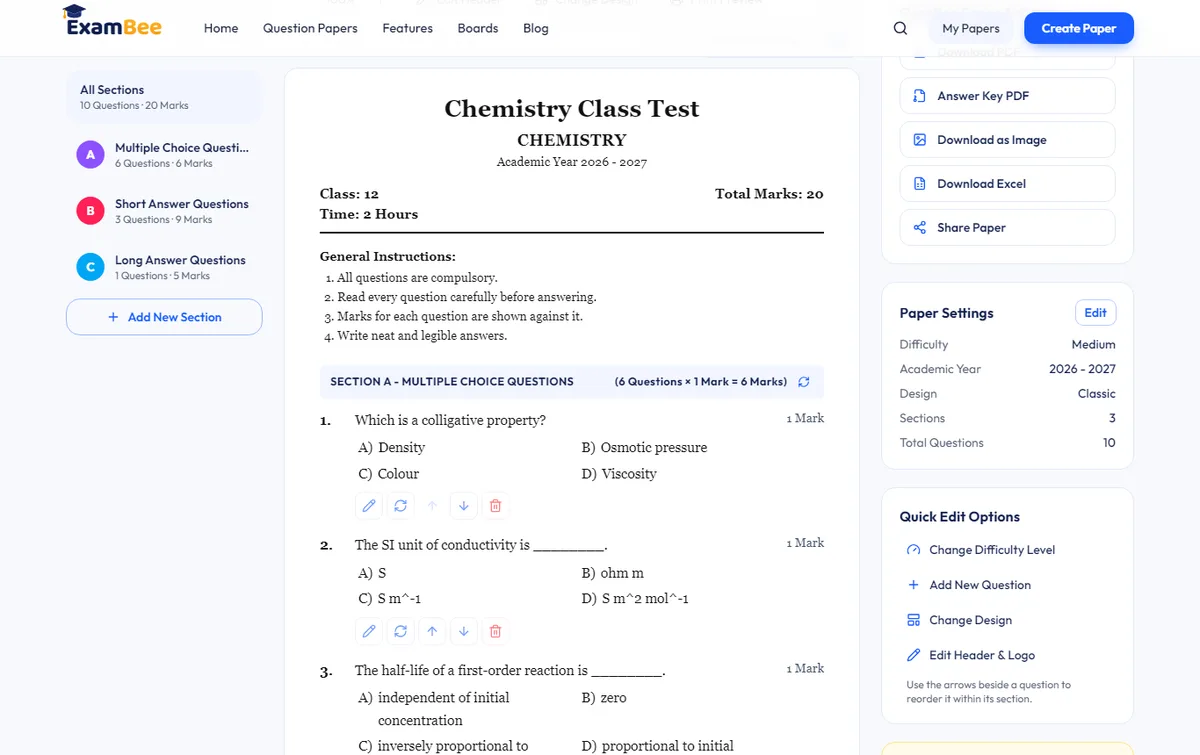
Every NCERT chapter of Class 11 and 12 Chemistry and Biology in ExamBee has questions of five types: multiple choice, fill in the blanks, true or false (with a mix of true and false statements), short answers worth 3 marks and long answers worth 5 marks, each with a model answer. When you choose chapters and set the number of each type, ExamBee picks questions chapter-wise so every selected chapter is represented, orders the paper with objective questions first, and prints section headings with marks. You can then swap a single question, regenerate one section at a new difficulty, add your own question, or change the paper design and school header - and download the paper and answer key as PDF, image or Excel.
A term plan for both subjects
| Fortnight | Chemistry test | Biology test |
|---|---|---|
| 1 | Basic Concepts + Structure of Atom | Living World + Biological Classification |
| 2 | Periodicity + Chemical Bonding | Plant and Animal Kingdom |
| 3 | Thermodynamics | Morphology + Anatomy of Flowering Plants |
| 4 | Equilibrium | Cell + Biomolecules + Cell Division |
| 5 | Redox + Organic basics | Photosynthesis + Respiration |
| 6 | Hydrocarbons | Human Physiology (two chapters per test) |
Repeat the same pattern in Class 12, giving Genetics and the organic chemistry chapters an extra test each. For help planning marks per section, read our question paper blueprint guide. Physics teachers can follow our CBSE Class 12 Physics guide, and ICSE schools our ICSE Class 9-10 Science guide. See every board and class on the supported boards page.
Frequently asked questions
How many chapters are there in NCERT Class 11 Biology?+
After rationalisation, NCERT Class 11 Biology has 19 chapters in five units: Diversity of Living Organisms, Structural Organisation, Cell, Plant Physiology and Human Physiology.
What is the unit-wise marks distribution for CBSE Class 12 Biology?+
In the 2025-26 curriculum the 70-mark theory paper is: Reproduction 16, Genetics and Evolution 20, Biology and Human Welfare 12, Biotechnology 12 and Ecology 10. Practicals carry 30 marks.
Which Chemistry chapters are in CBSE Class 12?+
Ten NCERT chapters: Solutions, Electrochemistry, Chemical Kinetics, d- and f-Block Elements, Coordination Compounds, Haloalkanes and Haloarenes, Alcohols Phenols and Ethers, Aldehydes Ketones and Carboxylic Acids, Amines and Biomolecules.
Are these question papers useful for NEET preparation?+
Yes, for concept practice. NEET is based on the NCERT Class 11 and 12 syllabus, and ExamBee's MCQs and short answers cover every NCERT chapter of Chemistry and Biology. NEET has its own pattern, so also practise official NEET papers.
Do ISC and Maharashtra HSC teachers get Chemistry and Biology too?+
Yes. ExamBee offers Class 11 and 12 Chemistry and Biology for ICSE (ISC) and Maharashtra State Board, organised by the same core NCERT topics.